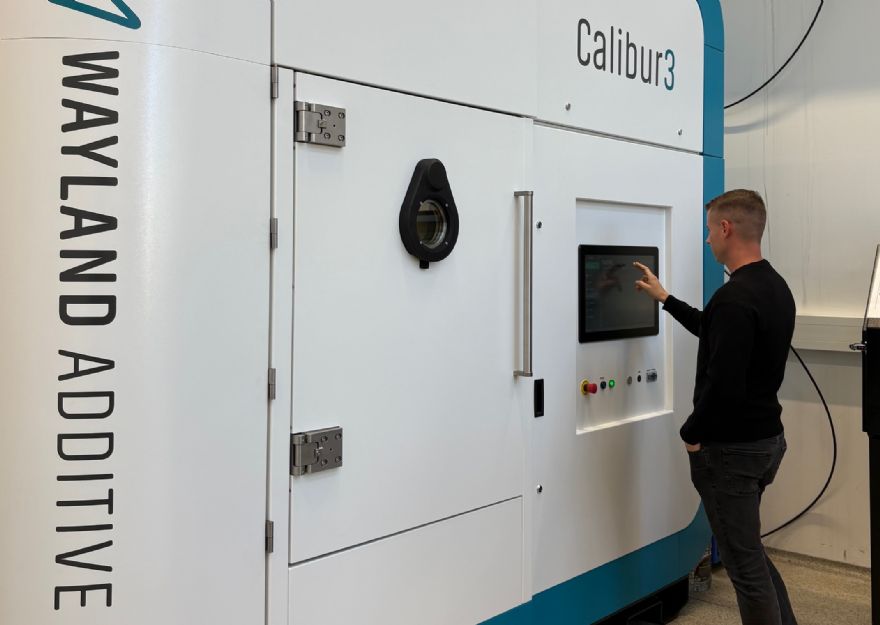
 Wayland Additive
has delivered its latest Calibur3 electron beam (eBeam) metal additive manufacturing (AM) system to the
University of Innsbruck, specifically within the Faculty of Engineering Sciences Department of Mechatronics and the Group for Materials Science.
The announcement follows a recent LinkedIn teaser shared by Wayland showing the latest Calibur3 system departing from its headquarters and production facility in Huddersfield, West Yorkshire. The destination can now be revealed as one of Austria’s leading research institutes for advanced materials and manufacturing.
The acquisition of the Calibur3 system reinforces the Innsbruck Faculty of Engineering Sciences' commitment to material and process development for metal AM, with a specific focus on processing ‘difficult’ and high-temperature materials.
According to Dr Lukas Zelger, coordinator of the Materials Science Group: "The Calibur3 is the first system of this new PBF-EB generation in Austria. What makes it stand out for us are its broad process monitoring capabilities as well as the innovative Active Charge Neutralisation technology.
“In combination, they allow us to follow a data-driven approach to push the limits of the technology, break new ground and to work in the processing gap between traditional PBF-LB and PBF-EB."
For the Innsbruck team, the rationale behind this purchase was based on the fact that traditional eBeam powder bed fusion (PBF-EB) systems require extensive pre-sintering of the powder bed to mitigate smoke events caused by electrostatic charging. Wayland’s proprietary NeuBeam technology neutralises the charge during the build process, unlocking unmatched operational flexibility and thermal control.
Dr Jakob Braun, senior scientist at the University of Innsbruck, commented: “I regard the Wayland Calibur3 machine as the most innovative PBF-EB machine for materials research on the market at the moment. This is because of the freedom in temperature management independent of an otherwise necessary pre-sintering step and full control of the scanning strategy in combination with high-speed, high resolution thermal imaging which is especially beneficial for adjusting the microstructures of the alloys to achieve the best material properties.”
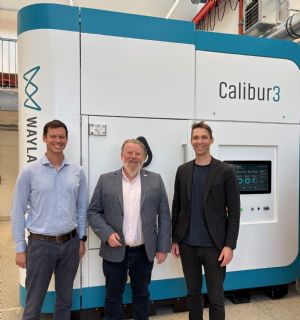
Beyond charge neutralisation, the system offers other key advantages for research and industrial alloy development, specifically the system’s open architecture and small build tank (SBT), which enables researchers to modify scan strategies, beam parameters and energy input in real time. In addition to this, the optional SBT, selected by Innsbruck, allows faster iteration and process development when using scarce or high-value alloy powders without requiring massive powder inventories.
The acquisition of the Calibur3 at the University of Innsbruck was made possible by the Austrian Research Promotion Agency (FFG) as part of the R&D Infrastructure Funding Program 2024.
Darrin Dickinson, head of business development (EMEA) at Wayland Additive, also commented: “We are incredibly proud to be able to supply our Calibur3 system to the University of Innsbruck after their open tender for a system to meet their needs. Lukas, Jakob and the entire team at the Innsbruck facility are at the forefront of materials science and AM research.
“The new Calibur3 installation, featuring our NeuBeam process, will greatly help their materials research and allow them to process materials in ways that have not been possible with other technologies. The installation of Calibur3 will open up new areas of research for the team and ultimately help them further their goals to work outside of the temperature constraints of other technologies in the market and to solve real-world processing challenges for high-performance metal alloys.”
Representatives from both Wayland Additive and the University of Innsbruck will be at Formnext in Frankfurt this November. Attendees are invited to visit the Wayland Additive stand (Hall 12, Stand B139) to discuss the latest research outcomes, explore Calibur3 applications and speak directly with the teams.