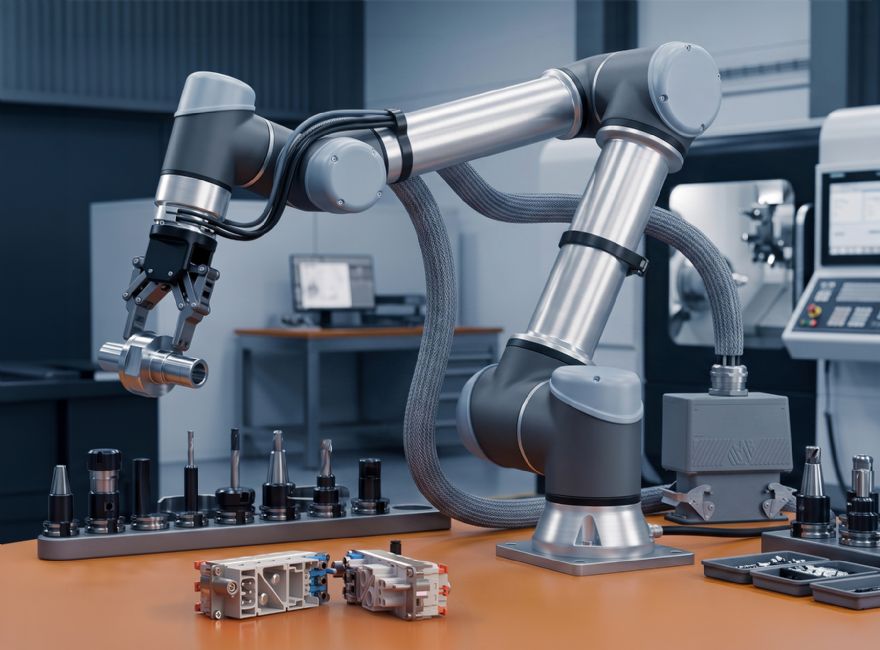
As collaborative robots become more sophisticated, machine builders are increasingly looking at ways to simplify the growing number of power, signal and data connections required within modern systems.
Cobots combine mechanical motion with motors, sensors, control systems, feedback devices and communications networks. While each function requires an electrical connection, the requirements of those connections can vary considerably. Power circuits often need different contacts and conductors to those used for low-voltage signals, while industrial communications may demand dedicated shielding and transmission capabilities to ensure reliable data transfer.
Traditionally, these functions have been handled through separate cables and connectors. However, as robotic systems become more compact and integrated, this approach can add complexity to machine design, installation and maintenance. As a result, engineers are increasingly exploring interconnect consolidation through the use of hybrid connector technologies.
A hybrid connector incorporates different connection types within a single housing or frame. Power, signal and data contacts can be accommodated within separate modules while sharing a common connector body. This allows multiple electrical functions to pass through a single interface without compromising the specific requirements of each circuit.
One example is the modular connector concept employed by systems such as ILME's MIXO range. These connectors can be configured with inserts designed for power transmission, signal wiring, data communications, optical signals and even pneumatic connections. The modular approach enables engineers to create application-specific connector configurations that combine several functions within the same connector frame.
The objective is not simply to reduce connector numbers. Instead, designers must ensure that each circuit continues to meet its own electrical, mechanical and environmental requirements. Power distribution, signal integrity and network performance all remain critical considerations regardless of how connections are packaged.
When designing robotic systems, engineers typically begin by identifying the circuits that need to pass between machine assemblies or moving axes. They can then assess whether compatible power, signal and communication functions can be integrated within a common connector architecture.
However, connector selection represents only part of the overall design process. Factors such as conductor size, cable construction, shielding, strain relief and environmental protection continue to play an important role. Likewise, mechanical considerations including cable flexibility, bend radius, weight and resistance to fatigue remain essential in applications involving repeated movement.
A consolidated connector arrangement does not automatically resolve these challenges. The performance of the complete interconnect system still depends on the design of the cable assembly and the mechanical routing strategy employed within the machine.
As collaborative robots continue to evolve, the management of power, signal and data connections is becoming an increasingly important element of machine architecture. Hybrid connector systems offer a potential route to simplifying these interconnect requirements while maintaining functionality and serviceability.
The trend reflects a broader shift in automation design thinking. Rather than treating connectors, cables and routing separately, engineers are increasingly considering contacts, inserts, housings, cable management and maintenance requirements as elements of a single, integrated interconnect system.
Industrial connectivity specialist
Mencom says this approach can help manufacturers manage increasingly complex machine architectures while supporting long-term reliability, maintainability and performance in automated applications.