Family-owned precision manufacturing firm
GW Martin, a majority of whose subcontract production involves turn-milling of complex components that frequently require surface treatment and assembly, was an early adopter of CNC technology in the early 1980s.
At that time, the company started replacing cam-type and plug-board autos in its Eastleigh factory with computer-controlled lathes. One of the initial machines to arrive was the first fixed-head Miyano lathe to be installed in the UK, delivered by a former sales agent for the Japanese machine builder.
The Miyano brand, along with Cincom sliding-head lathes, now belongs to
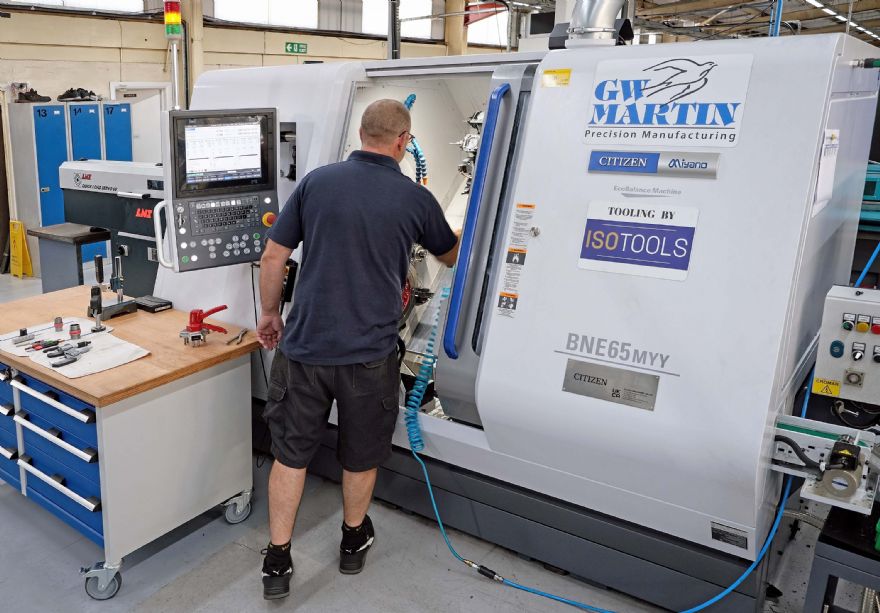
Citizen Machinery in Japan, whose UK subsidiary supplied in March 2026 two Miyano BNE-65MYY turning centres to GW Martin.
It increased to five the number of these bar-fed, twin-spindle machines currently on the shopfloor, while there is also a 20mm capacity Cincom on-site. Together they account for a quarter of the CNC lathes that the subcontractor operates for bar and billet work, many of the other machines being highly automated with robotic component loading or gantry feed systems.
Numerous Miyano lathes have come and gone over the years due to regular renewal of plant, overseen since 2011 by a young management team headed by managing director Stuart Yalden, grandson of George Martin, who founded the company in 1959.
A modernisation programme has seen more than £3 million invested in the past five years in new machines and inspection equipment, replacement flooring and lighting, a new roof, and a studio with a CNC lathe, mill and 3D printer to train apprentices, there being six among the present 55 employees. Solar power, which supplies 30% of annual demand, and the purchase of only renewable electricity through the grid mean that the Eastleigh factory is net-zero.
Mr Yalden commented: “Our staff are very pleased with the performance of three twin-turret, ABX-type Miyanos in our factory in terms of their power, rigidity and accuracy for producing large-diameter steel parts, so Citizen is one of our two main suppliers of lathes.
“Earlier this year we needed extra capacity for manufacturing larger quantities of two nearly-identical, mild steel components for a customer.
“We had been keeping an eye on the twin-turret, 65mm bar capacity Miyano BNE-65MYY with a view to transferring some of the production to this smaller-footprint yet still very robust lathe.
“So, we instigated production trials at Citizen Machinery UK’s turning technical centre in Brierley Hill.”
Trial collaborationDuring the trials, Citizen’s applications department teamed up with GW Martin’s engineers and the subcontractor’s tooling supplier, Fareham-based Isotools, to investigate whether the BNE turn-milling platform was optimal for producing the pair of mild steel parts. Indeed, it proved to be.
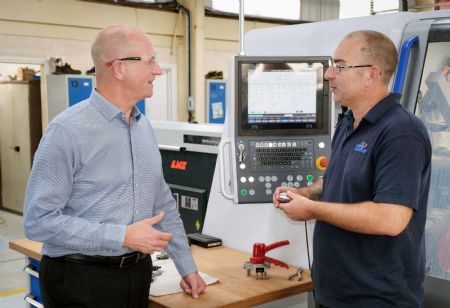 Pic: Stuart Yalden, managing director, GW Martin with workshop supervisor Darren Fitall
The more complex of the two parts, which was especially tightly toleranced, was produced in approximately the same cycle time as on a different twin-turret lathe in Eastleigh. However, the superior vibration resistance of the Miyano led to lower tooling costs, as significantly fewer cutters were needed to complete a given quantity of components. Furthermore, it was easier to achieve the required accuracy.
When producing the other component, similar benefits were gained and in addition there was a reduction in cycle time from 302 to 200 seconds, resulting in 50% higher productivity. The outstanding performance prompted GW Martin to buy not one but two of the BNE lathes, both of which were installed and commissioned at the same time.
The first machine is devoted to producing the mild steel parts. The second lathe provides redundancy should there ever be a problem with the first BNE and also allows more flexibility in work allocation across the shopfloor. It has enabled an increase in production output on certain components that have been reassigned to it, shortening delivery lead-times to customers.
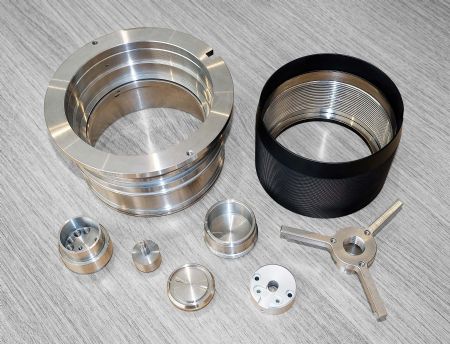 Pic: A selection of components produced on the Miyano lathes
Between March and July 2026, three components were produced on the second BNE-65MYY, a 10-axis lathe with two live 12-station turrets having Y-axis movement. The first part came off the machine more than one third faster at 3.5 rather than 5.5 minutes.
The second, a 316 stainless steel spigot housing for a petrochemical industry flow meter, had what appeared to be preposterous drawing tolerances of five microns relative to two diameters and the front face. It too was produced 30% faster, but the biggest benefit was a six-fold reduction in scrap rate, down to just 5% on the Miyano.
The third part is being produced in half the time, but that is compared with an earlier-generation ABX Miyano dating back to 2007.
Aerospace ambitionsModern, highly productive, extremely precise machine tools like the BNEs are clearly ideal for fulfilling aerospace contracts and GW Martin is keen to push further into supplying this sector, with AS9100 quality management system certification expected before the end of 2026. Although not yet implemented, advantage will be taken in this and other work of superimposed machining built into the BNE’s Mitsubishi control, which was another reason for opting to buy the latest lathes from Citizen.
This functionality simulates the production capability of a three-turret lathe by allowing a component held in the two-axis sub spindle to track the upper turret as it machines a component in the main spindle. It means that a parted-off component can engage tools on the reverse side of the turret so that three tools can be in cut simultaneously.
The future of GW Martin is assured, not only by its modern approach to design for manufacture, production, assembly, quality and logistics, but also due to the prescience of George Martin, who purchased the freehold of the 13-acre site in Eastleigh in 1967. It cushions the firm financially during recessionary periods and provides enough space to more than double the size of the 25,000ft² manufacturing facility should the need arise.