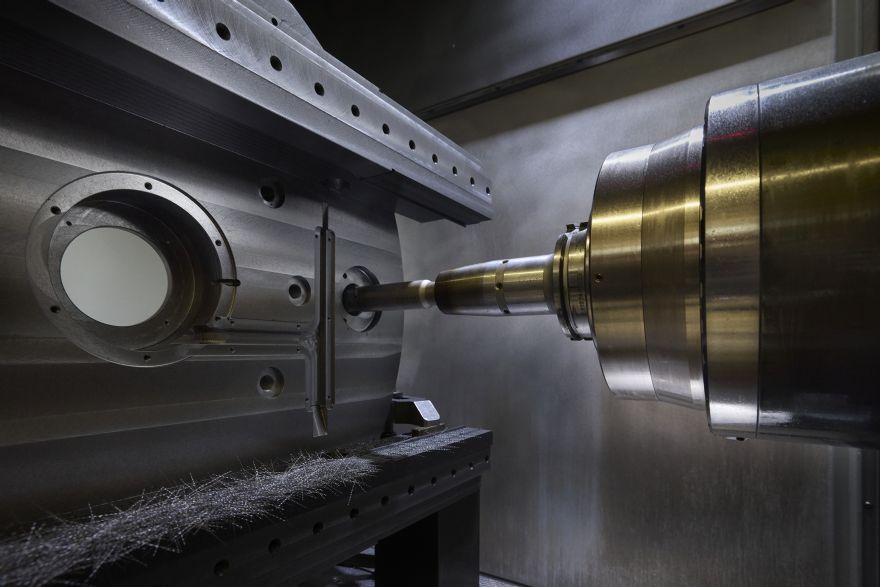
For manufacturers of precision machine tools, accuracy is everything. At
KAPP NILES' production facility in Coburg, Germany, even the smallest deviation can have a significant impact on the performance of the company's gear grinding machines, which are used to produce highly accurate gears and profiles for industries ranging from automotive to general engineering.
That is why the company viewed the replacement of a key machining asset as far more than a routine investment. In 2024, KAPP NILES replaced a 16-year-old jig boring machine with a high-precision Heckert HEC 800 machining centre supplied by
Starrag, a move that Sascha Forkel, Head of Cubic Machining, describes as a "heart transplant".
"It is a key machine in our production operations, without which we would no longer be able to supply," he said.
The machine is responsible for finishing some of the most critical components used in KAPP NILES gear grinding systems. Under Forkel's management, the Coburg facility machines cubic components up to one cubic metre in size, producing the structures, housings and assemblies that form the backbone of the company's machines.
Engineering for micron-level accuracyTo meet KAPP NILES' requirements, Starrag refined numerous aspects of the machine specification. Thermal stability formed a major part of the package, with water cooling applied to machine stands, drives and ball screws. Temperatures are actively controlled within ¡Ó1K to minimise thermal distortion, while heat-generating elements such as motors and hydraulic systems are isolated from accuracy-critical machine structures.
Additional measures included hand-finished guideways to improve positioning accuracy and further optimisation of the machine's rotary axes. Particular attention was paid to reducing wobble in the B-axis because bearing bores must be machined from multiple directions, demanding extremely accurate indexing.
The spindle was another area where precision took precedence over outright performance. Rather than selecting a geared spindle arrangement, KAPP NILES opted for a direct-drive solution developed by Starrag.
"The smallest inaccuracies of a gear spindle would have been too much for us," said Forkel. "We even limited the maximum speed from 12,000rpm to 10,000rpm to achieve higher process reliability."
Acceleration rates and rapid traverse speeds were also reduced to limit vibration. According to Krause, discussions between the two companies often focused on seemingly small details that could influence overall machine performance.
"We discussed a great deal in this phase and specified the plans down to the last detail, including the gentle positioning of the pallet at the set-up point," he said. "If this is done too roughly, vibrations occur that continue into the machine."
Alongside precision, usability was also considered. Access platforms, handrails and steps were incorporated to improve safety during set-up and inspection tasks, while an automatic drilling system was added to the specification.
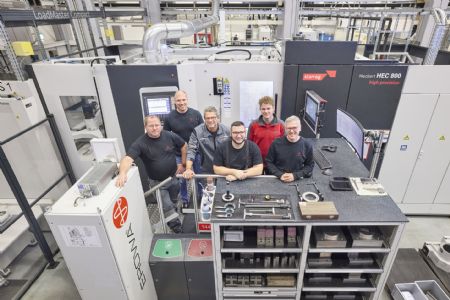
Automation formed part of the project from the beginning. To maximise productivity, Starrag integrated an Erowa LoadMaster pallet handling system capable of managing nine workpiece carriers. Six pallets were supplied in a standard precision-machined configuration, while three were hand-finished for components with the most demanding accuracy requirements.
Today, the Heckert HEC 800 occupies the same footprint as its predecessor while offering significantly higher productivity. Less critical workpieces can be processed automatically, allowing operators to focus on the most demanding tasks.
Most importantly, the transition proved successful. Rather than following a phased introduction, KAPP NILES took the bold step of removing the old machine before the new one arrived. The Heckert HEC 800 was installed in August 2024, accepted in November and entered full production in January 2025.
"Granted, the cut was a bold move," said Forkel. "But through close contact with the Chemnitz-based Starrag experts, we assessed the risk of anything going wrong during the exchange and the new Heckert not delivering from the beginning as relatively low.
"Our conclusion: The heart transplant was a complete success."
"These are key components for our machines, which are used for the high-precision manufacture of toothing and profiles," he explained.
The tolerances involved are exceptionally demanding. Components must achieve shape, positional and dimensional accuracies of up to 3µm to ensure the finished machine can produce gears that run smoothly and quietly. Following pre-machining operations, allowances of just 0.3mm remain on critical surfaces, while bore holes retain only 1mm of additional material before final finishing.
"During the finishing process, we operate within tolerance ranges of a few micrometres, not only for shape and position, but also for the relative positions of the components," said Forkel. "The surfaces must also be of the highest quality."
Selecting the new heart of the factoryWith spare parts becoming increasingly difficult to obtain for the ageing jig boring machine, KAPP NILES decided to replace the equipment before reliability issues could threaten production.
The search for a successor was rigorous. Following an initial market review, three suppliers were shortlisted. Operators and NC programmers were heavily involved throughout the process, reflecting the importance of finding a solution capable of consistently delivering micron-level precision.
To ensure a fair comparison, all three contenders machined the same highly complex motor housing using identical pre-machined parts, clamping systems, tools and NC programs. KAPP NILES personnel prepared and clamped the components themselves to eliminate variables between tests.
"Experienced machine operators and NC programmers who work on the machine are required," said Forkel. "The machine will be the new heart of our production, but it is not solely responsible for success. Only when the machine, operator, and NC programmer work together in perfect harmony can the components be manufactured to high precision."
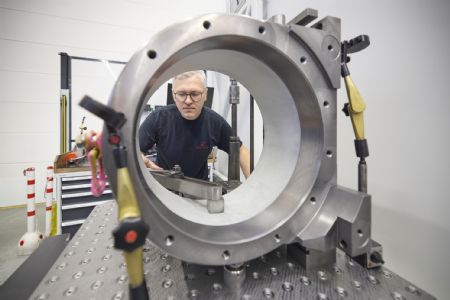
The completed components were then measured using the same metrology equipment at KAPP NILES. Based on the results and a range of technical criteria, the company selected Starrag's Heckert HEC 800, equipped with a dedicated high-precision package and several customer-specific enhancements.
A key differentiator was mechanical accuracy. While software compensation can improve machine performance, KAPP NILES wanted inherent precision built into the machine structure itself.
Rainer Krause, Area Sales Manager at Starrag, said: "Heckert machining centres already have high mechanical accuracy. It is within a tolerance range that is only half the size of what is typical for machining centres."
Forkel noted that reliance on software compensation can introduce unwanted effects in demanding machining operations.
"We generally produce bore holes on this machine with single-edged tools. Compensation across several axes can cause warping, meaning the bore hole is not cylindrical. This is a no-go for us."