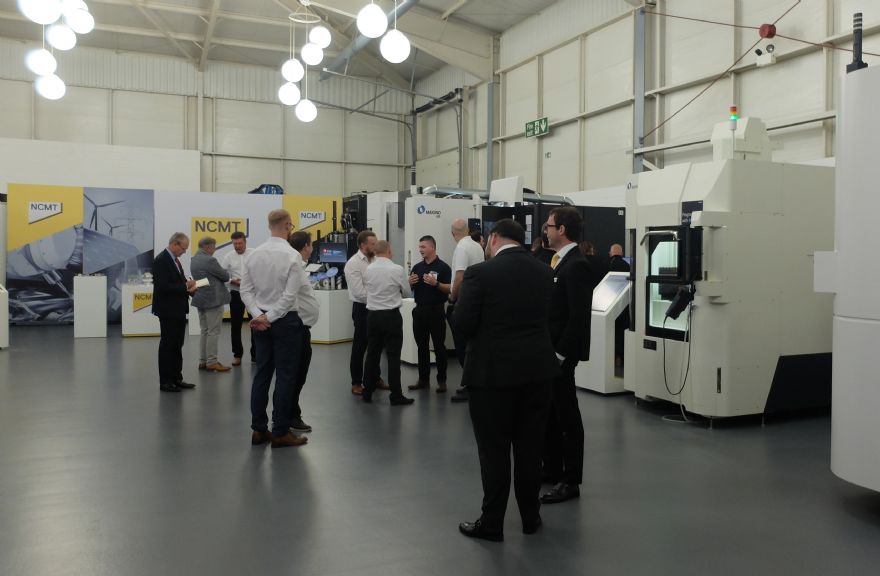
 From precision grinding and five-axis machining to EDM drilling, NCMT recently showcased the technologies and expertise required for modern turbine blade manufacturing.
In early September,
NCMT in Coventry held a two-day ‘Engineered for Power’ event focused on the production of turbine blades and power generation. As the UK agent for both
Makino and
Okuma, the company used the event to showcase a range of machining technologies and manufacturing solutions from the two machine tool builders.
What gave the event its distinctive appeal, and perhaps best demonstrated the breadth of Makino and Okuma's capabilities, was the variety of processes on display. From traditional metal cutting to grinding and EDM, the equipment demonstrated how different technologies come together in the manufacture of components that must perform reliably in some of the most demanding operating environments.
Going with the grindThe event featured advances in grinding, metal cutting and EDM, with particular attention given to the new Makino G5 grinding machine equipped with the Pro6 control. This five-axis horizontal machining centre combines grinding, milling and drilling in a single platform.
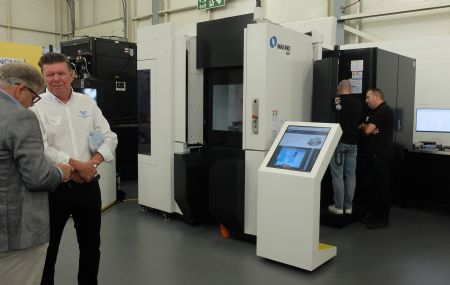 Pic: The new Makino G5 5-axis horizontal machining centre can grind mill and drill on a single platform
Makino's heritage in grinding is well established. Working alongside Rolls-Royce and grinding wheel manufacturer Tyrolit, the company developed the VIPER grinding process for the precision machining of aerospace superalloys. The creep-feed grinding process uses high-pressure coolant delivery to achieve high material removal rates while maintaining process stability.
The application of coolant at high pressure is central to the process, enabling coolant to penetrate the grinding wheel during machining so that cooling is continually applied directly at the workpiece surface.
Stewart Seedhouse, grinding applications manager at NCMT, explained: “Having porous grinding wheels fundamentally changes how coolant does its job. It does not just wash over the process. It is used to scrub the wheel clean, and is then forced into the wheel structure, so the wheel carries coolant right to the point of cut. Effectively, it is a continuous cooling method that helps keep the workpiece cool and stable during grinding.”
Over the years, NCMT has continually refined its coolant delivery systems. The latest nozzle design uses additive manufacturing and fluid-dynamics modelling to achieve laser-like accuracy in directing coolant to the grinding zone.
“The original VIPER process started by feeding coolant into the wheel from behind the cut, and later we changed the nozzle designs to let us swap cutting direction quickly, especially useful on complex parts,” Mr Seedhouse noted. “However, some of those solutions were so sensitive that being even a millimetre out could ruin a part, because coolant placement is absolutely key to process reliability.”
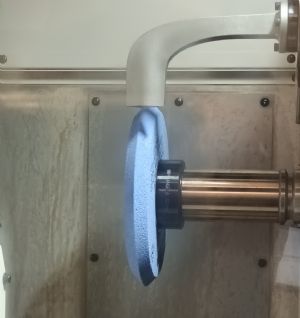 Pic: The G5 Grinding wheel with additively made coolant nozzle
Now the nozzle is a single-piece component with internal channels optimised to direct coolant precisely to the cutting point of the wheel. The design also removes the need for a fabricated assembly, reducing wear and helping to maintain performance over time.
“We have redesigned it to remove weak points and have better control of the flow,” Mr Seedhouse added. “Now the coolant goes exactly where we want instead of exploding outward and dispersing. This supports better cooling and scrubbing and allows for more aggressive processing.”
Another major development on the G5 is its software and control architecture. NCMT’s Easy-Grind Max+ software has been developed specifically for VIPER grinding applications over many years.
A newer addition to the NCMT software lineup is what the company calls its Adaptive Grinding System (AGS). Designed to simplify machine setup, AGS automatically recalculates every machined feature updating all five axis, (including the nozzle) whilst maintaining the original cut parameters, reducing the risk of programming errors. The system is intended to make complex grinding operations, particularly those involving turbine blades, vanes and other high-value aerospace components, risk free with every part in tolerance.
“It changes how difficult parts can be approached. For components with challenging datum structures or clamping risks, where operators may scrap parts because holding and positioning are so sensitive, the adaptive approach lets you focus on securely holding the part and then letting the system compensate,” Mr Seedhouse says.
“It means you can approach grinding with a different mindset. You do not always need perfect positioning, just secure holding, because the AGS system takes care of the positioning you can focus on the machining.”
Flexible five-axis machiningMoving from grinding to metal cutting, NCMT demonstrated what it terms Blade in One machining on an Okuma Multus B200II a twin spindle multitasking machine. The demonstration highlighted the flexibility of the compact machine, particularly when combined with Okuma's OSP 500 control and Hyper Surface technology.
The objective was to show how a complex component such as a turbine blade can be machined complete with the required surface finish, removing the need for secondary operations such as polishing.
Richard Turner, general manager, Okuma products at NCMT, explained: “In this demonstration, we start with a raw piece of material, in this case bar, then we machine the root of the blade, the aerofoil and then part it off, so the complete component is produced in one hit. Normally, you would need multiple machines, so this is a big step change. We do it on a multitasking platform with a very high level of accuracy and control.”
Okuma's Hyper Surface CAM-path compensation software plays a key role in achieving the Blade in One concept.
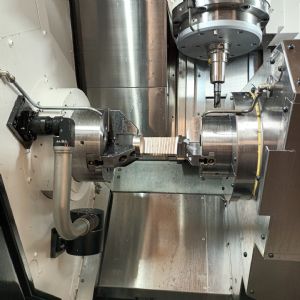 Pic: Blade in One machining on the Okuma Multus B200II
The intelligent CNC function automatically detects and compensates for interruptions in CAM-generated toolpaths, helping improve surface quality and minimising visible machining marks.
“The Hyper Surface function is about smoothing surfaces,” Mr Turner says. “The control monitors what is coming ahead, but it also looks at what the toolpath has just produced, so it is constantly monitoring and adapting to generate a smooth surface finish.”
For subcontract manufacturers, one of the machine's key attractions is the versatility it offers within a relatively small footprint.
“This machine can be used to produce complex parts such as turbine blades and then fulfil an order for thousands of turned fasteners with milled hex heads. It is that versatility that makes it so ideal for a shopfloor handling multiple orders,” Mr Turner notes.
Solutions with a sparkWhile machining and grinding are central to blade manufacture, many turbine blades and vanes, particularly those used in aero engines, also require precision cooling holes. These features allow components to operate in extreme temperatures while maintaining service life.
Makino's BX3 EDM machine has been designed primarily for this task, although its capabilities extend beyond turbine blade applications.
The machine combines submerged EDM drilling, high-pressure flushing and multi-axis workpiece positioning to produce complex cooling-hole patterns in a single setup.
Using electrodes ranging from 0.2mm to 3mm in diameter, the BX3 can produce the fine holes required in turbine blades. It can also machine intricate entry geometries around the holes to improve airflow.
Andy Garratt, general manager for Makino products at NCMT, says the machine's primary advantage is its submerged machining capability.
“Submersion improves hole quality because the process constantly flushes chips away from the cutting zone, which helps prevent secondary sparking. It also keeps the tank and the machine cleaner overall, and eliminates splashing, a big benefit in day-to-day production,” he explained.
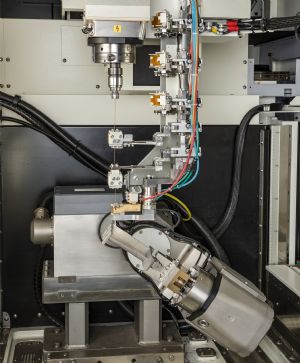 Pic: The Makino BX3 EDM cutting coolant channels into a turbine blade
He added that submersion also improves breakthrough detection, particularly in aerospace components containing internal cavities. The BX3 incorporates an integrated system that detects when an electrode penetrates a component wall and prevents further travel and back wall impingement.
In addition, the automatic tool changer accommodates up to 24 pipe electrodes, reducing operator intervention when drilling large numbers of cooling holes.
Mr Garratt said: “This machine is a game changer in the production line. The speed at which it can produce holes is very fast and the throughput is unbelievable.”
As well as the machines on display, a number of NCMT's technology partners were present, showcasing complementary grinding wheel, tooling, software and metrology solutions used in turbine blade manufacture.
With demand for turbine blades and similar components continuing to rise, driven by aerospace, defence and power generation programmes, NCMT's decision to focus on these applications could hardly have been better timed. For manufacturers involved in producing such components, the company's combination of machine tools, process knowledge and application expertise makes it a valuable partner.
Summing up why the company had staged the event, sales director Ian Horton said: “Today was about showing a complete manufacturing environment, not just a single machine in isolation. We brought together multiple machines, as well as software and tooling partners, to demonstrate how these technologies work together in a real production setting. Rather than a traditional open house, this was a targeted event focused on power generation and aerospace blades, designed to get in front of OEMs, Tier 1 suppliers and subcontractors and show them the bigger picture.”