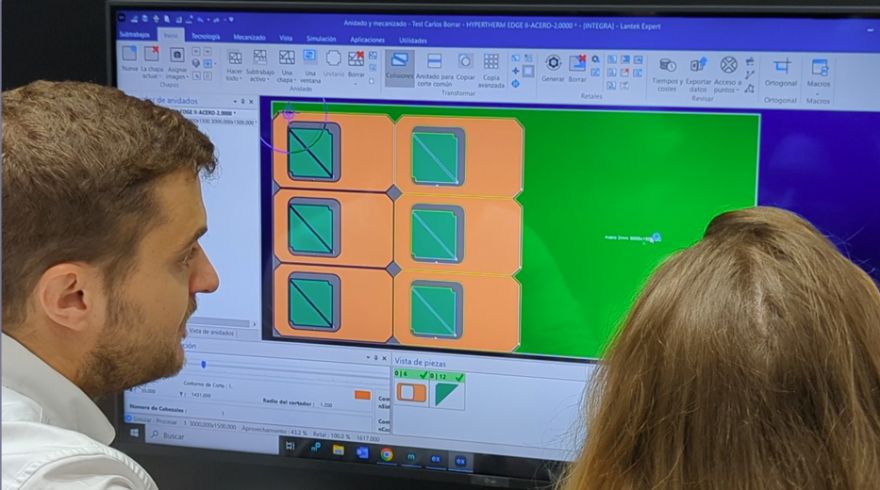
 In this article Adam Ball, Commercial Director at sheet metal software specialist Lantek, explains why true material efficiency depends on looking beyond nesting on sheet metal and across the whole production chain.
Ask some sheet metal fabricators what 'material utilisation' means and they will point to the nest: how tightly parts are packed onto a sheet, how little offcut is left over and how much scrap goes in the skip at the end of the shift. That is not wrong, but it is only part of the picture. Real material efficiency is not something that happens at a single stage of production. It is the outcome of decisions made right across the process, from how a part is first programmed through to how it is handled once it comes off the machine.
Treating nesting as an isolated exercise is where many machine shops may be going wrong. A nest can be mathematically efficient and still create problems downstream, for example, parts in the wrong sequence for assembly, awkward handling because of how they have been oriented, or bottlenecks further along the line because output does not match the pace at which operators can process it. Efficient use of material has to be considered alongside effective use of time, labour and machine capacity.
The whole production chainThe starting point for genuinely improving optimisation comes from analysing the full value chain. That means examining how individual parts are programmed, how those parts are then combined into complete nests and how the resulting output flows into cutting, forming, punching and assembly. Each of those stages has traditionally been treated as a separate discipline, often handled by different people using various tools and individual interpretations. The result is a process that can be efficient in patches and disconnected as a whole.
Streamlining and automating the programming of both individual parts and complete nests removes a great deal of that friction. When part programming and nest programming are connected rather than siloed, decisions made at the part level - how a hole is cut, which edge is pierced first, where a lead-in is placed, can be made with the finished nest and the finished job in mind, rather than in isolation.
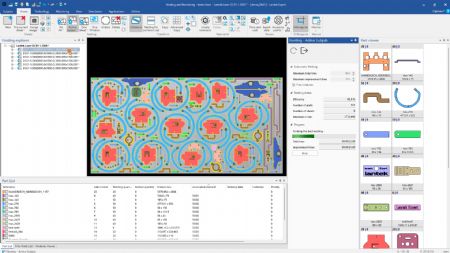
This is particularly important as parts themselves become more complex. Modern software needs to support advanced machining strategies and increasingly intricate combinations of operations within a single part or a single nest - different cutting technologies, multiple tool changes, engraving, marking and forming operations sequenced correctly against one another.
Automating this level of complexity is not a luxury; without it programmers spend disproportionate amounts of time manually working through combinations that software should be resolving in seconds and that lost time erodes any material savings made elsewhere.
Synchronising machine output with human workflowThe other half of the equation is the shopfloor itself. However well a sheet is nested, if the resulting parts land on the operator in a jumble, with no relationship to how they will be picked, sorted or assembled, the efficiency gained at the machine is quickly lost in handling. This is where nesting needs to think beyond the geometry of the sheet and start reflecting the logic of the workflow around it.
Nesting software that mirrors natural production sequences - arranging parts so they emerge from the machine in the order they are actually needed - closes that gap. Rather than a nest being optimised purely for material yield, it can be organised so that parts for the same assembly, delivery, or the same downstream operation come off the machine together and in the right order. Operators are not left cross-referencing drawings or hunting through a pile of components to find what they need next; the sequence has already been built into the plan.
The effect of this is felt well beyond the immediate output of the laser or press. Assembly teams receive components in a logical order rather than at random. Sorting and kitting time is reduced because the groundwork has already been done digitally rather than manually on the shopfloor. Turnaround times improve, not because any individual machine is running faster, but because the handling and decision-making around it has been simplified. And because much of the manual sorting and cross-checking is removed, the opportunity for errors, the wrong part going to the wrong job, or a component being missed entirely is significantly reduced. Synchronising machine output with human workflow in this way turns nesting from a purely material-driven exercise into a genuine production planning tool.
Extending optimisation beyond cuttingHistorically, this level of sophistication has been most closely associated with laser and plasma cutting, where nesting software has matured over many years to handle complex geometries and mixed-technology sheets. But material efficiency and workflow synchronisation are just as relevant to other sheet metal processes and it is important that optimisation is not confined to one part of the shopfloor while others continue to operate on older, less connected methods.
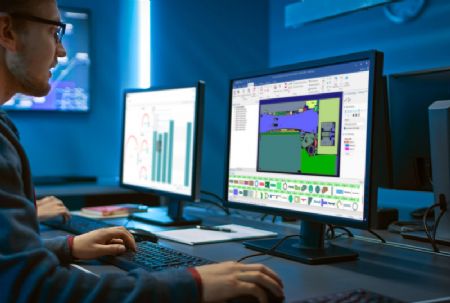
That is why the latest advances in this area matter. A key development with Lantek v46 is the extension of NOS (Nesting Optimisation Service) to punching machines. Previously available only for cutting technologies, our most advanced nesting engine now brings its material optimisation capabilities to punching environments, extending advanced optimisation across a broader range of sheet metal technologies.
For manufacturers running mixed environments, such as combining punching with laser or plasma cutting, this consistency matters. It means a single, coherent approach to material and workflow optimisation across the shopfloor, rather than a strong strategy on one machine undermined by a fragmented one on another.
Staying ahead through connected thinkingThere is no single formula that suits every fabricator and nesting strategies will always need to flex with order volume, material availability, delivery requirements and shop floor capacity. What does not change is the underlying principle: material utilisation cannot be improved in isolation from the rest of the production process. The machine shops that achieve the most value from their nesting strategy are those that treat it as one connected part of a wider system. Here it links part and nest programming, aligning machine output with human workflow and applying that same thinking consistently across every relevant technology on the shopfloor, from cutting through to punching.
As machines continue to increase in speed and parts continue to become more complex, that connected approach is only going to become more important. The machine shops who invest in it now will be the ones that gain a competitive edge.”
Founded in 1986, Lantek is the global leader in software solutions for the sheet metal industry. Its products enable companies to optimise manufacturing processes with cutting-edge technologies for CAD/CAM, MES, ERP, and analytics. For more details, visit
www.lantek.co.uk