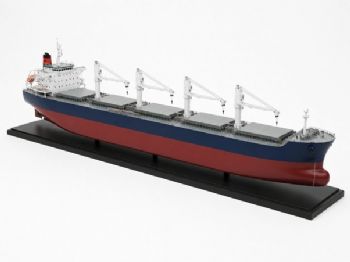
 Marea Scale Models
 has launched in the UK, introducing an AI-assisted design process that aims to speed up the production of maritime scale models while maintaining the craftsmanship and hand-finished detail expected by customers.
The company's proprietary Ai Refloat technology has been developed to tackle one of the longstanding challenges in ship model making: accurately reproducing the distinctive features of full-sized vessels at scale without lengthy redesign work or the loss of important details.
Already used on the company's first commercial commissions, the system allows Marea to create detailed digital models that preserve vessel-specific characteristics before production begins. The approach is designed to reduce the amount of manual reworking traditionally required when converting large, complex ships into smaller display models.
The company recently delivered several commercial commissions for an international maritime client within two months, including container ships, bulk carriers and crude oil tankers. Each model was individually assembled, detailed, painted and finished by hand to ensure it remained instantly recognisable as the vessel it represented.
Producing accurate ship models involves more than simply reducing the dimensions of a vessel. Features such as railings, deck equipment and structural elements that are clearly visible on a full-sized ship can become fragile, indistinct or difficult to manufacture when reproduced in miniature.
Traditionally, model makers have addressed these challenges through extensive manual design adjustments before production starts, often having to simplify or compromise certain details as dimensions become smaller.
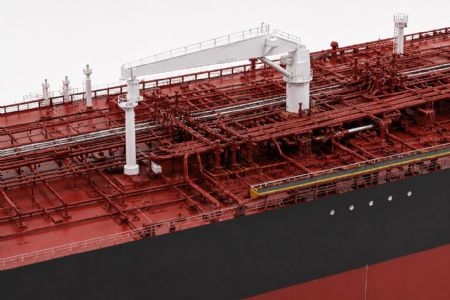
Marea says Ai Refloat allows these challenges to be addressed earlier in the process, helping preserve vessel-specific characteristics while improving efficiency. The company is able to reproduce details as fine as 30 microns (0.03mm), enabling features that might otherwise be lost during scaling to be retained in the finished model.
Rezz Ghanty, creative director of Marea Scale Models, said the technology was developed to improve the design process rather than replace traditional craftsmanship.
"Speed on its own is not the point," he said. "The purpose of the technology is to remove delays from the parts of the process where they add no value, without taking time away from the finish. The model still has to be completed by hand and judged by eye.
"I did not set out to establish another model-making company. I became interested in a problem the industry has lived with for generations: why should making a vessel smaller automatically mean accepting less of what makes it distinctive?
"Every model presents difficult choices. A railing becomes too fragile, a fitting loses definition, or an important structural feature begins to disappear. Ai Refloat allows us to address those problems before production begins rather than correcting them once the model reaches the bench."
While AI is increasingly being adopted across a wide range of industries, Mr Ghanty emphasised that the technology is used only during the design stage.
Once a design has been approved, Marea's team carries out the assembly, painting, detailing, finishing and weathering of each model by hand. The company's master model maker, who has more than 30 years of experience, oversees the final surface treatment and finish of every commission.
"Technology should not replace skilled people," Mr Ghanty said. "It should allow them to concentrate on the areas where judgement and experience matter most.
"Our model makers should be refining a finish, correcting a detail and bringing the character of a vessel into the model rather than repeatedly solving the same technical scaling problems.
"The aim is not to make the craft less important. It is to give our model makers more time to apply it."
Marea's initial focus is on merchant shipping, producing models of container ships, cargo vessels, bulk carriers, crude and product tankers, and VLCCs. The company says accuracy is particularly important for technical vessels, where details such as manifold arrangements, pipework, deck equipment and containment systems can be critical to capturing the identity of a specific ship.
Alongside large display models, Marea also produces smaller presentation models made from recycled marine waste materials. Offered in limited runs of 10 units, these are designed for occasions such as newbuild deliveries, naming ceremonies and fleet milestones.
"For the client, the value lies in recognising the vessel immediately," Mr Ghanty said. "It is not enough for the model to represent the right class of ship. It has to capture the features that make that particular vessel distinct. That is where the details matter. They are what give the vessel its identity."
He added: "We believe maritime model making has reached a point where technology can support craftsmanship without diminishing it.
"Our aim is to give clients a more responsive production process while ensuring that every model remains recognisable as the vessel it was commissioned to represent."