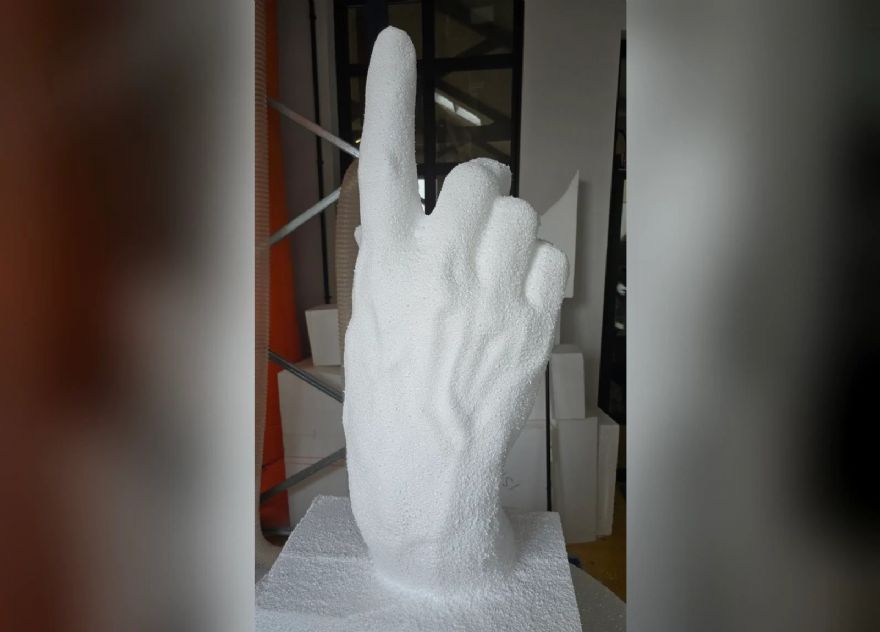
A one metre hand sculpture created for a Spanish art exhibition has demonstrated how robotic machining technology can be used to rapidly scale up complex artistic designs. Produced by Spanish engineering specialist
MecDATA for sculptor and ceramic artist Natàlia Ferré, the project saw a 21cm original artwork enlarged almost fivefold while retaining its intricate details and proportions.
Commissioned for display at the Natàlia Ferré Gallery in Tarragona, the sculpture required the precise reproduction of features including finger proportions, palm creases and subtle surface transitions. MecDATA,
ENCY's partner in Spain, was responsible for the digital preparation, programming and machining of the enlarged piece.
The original sculpture was first digitised using a
3DeVOK scanner, generating a mesh model that was checked and refined in Rhino. The geometry was then scaled to the required height and carefully positioned to ensure the robotic machining process could access all areas of the model, including recessed sections around the bent fingers.
Particular attention was given to the layout of the workpiece. Clearance had to be provided for both the spindle assembly and the robot arm, while stock dimensions and the height above the machining table were optimised to minimise material use. A sacrificial base was also incorporated, allowing the spindle to approach the workpiece from different angles during machining.
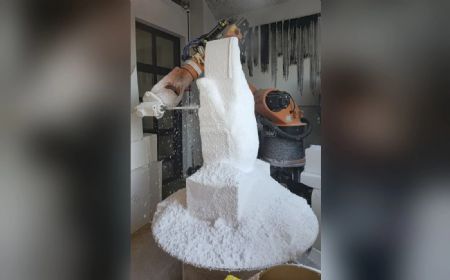
Once prepared, the model was imported into ENCY Robot and positioned within a virtual robotic cell. MecDATA engineers generated multi-axis milling toolpaths before simulating the machining process and verifying robot movements. The software enabled programmers to monitor tool approaches, inspect difficult-to-reach areas and identify any potential collisions involving the spindle, workpiece or cell components before production began.
The machining strategy combined roughing and finishing operations. Roughing passes removed the bulk of the polystyrene foam stock and established the overall form of the hand, while finishing operations reproduced the finer details, including the curved fingers, recessed sections and surface textures. Tool orientations were adjusted throughout the process to ensure the robot could maintain optimal cutting conditions across the entire sculpture.
According to MecDATA, creating the machining programme in ENCY Robot took just 30 minutes. After verification, the program was transferred to a KUKA robot, which machined the one metre sculpture from polystyrene foam.
The project also highlighted the role of ENCY Clouds, the company’s cloud-based collaboration platform that enables CAM programmers, shopfloor staff and technical support teams to share and review manufacturing projects. Through a browser-based viewer, users can inspect geometry, tooling, machining operations and process parameters without needing access to the desktop CAM application, simplifying collaboration and project review.