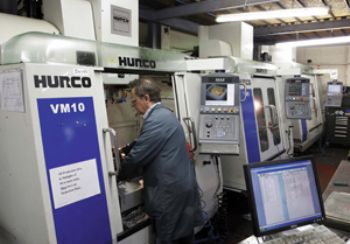
Dawnlough, the Galway-based sub-contract machinist that specialises in manufacturing components for the medical industry, has bought equipment to the value of £1.5 million since 2005 to expand its design, production and inspection capabilities.
The purchases include eight vertical machining centres (VMCs) and a driven-tool lathe from High Wycombe-based Hurco Europe Ltd (Tel: 01494 442222 – www.hurco.co.uk); these were supplied through local sales representative Michael Gannon. Other investments include Solidworks/Solidcam CAD/CAM seats, a CMM and vision system from Mitutoyo, two Fanuc wire-cut EDM machines and a Citizen sliding-head lathe. Financial assistance was secured from Enterprise Ireland, the Government agency responsible for supporting Irish businesses in the manufacturing sector.
Established in 1990 by Patrick McKeon, father of current company director Brian, the sub-contractor started out as a general tool-making company focusing on press tools. From the mid-90s, medical firms started ‘springing up’ across Ireland, especially in the Galway area, and Dawnlough concentrated increasingly on this sector.
Today, almost all of its business is in the design and production of special-purpose jigs and fixtures to assist in the manufacture of catheters, stents and other items for treating vascular and neuro-vascular disorders. Dawnlough has ISO 9001:2008 accreditation and is in the process of fulfilling the requirements for ISO 13485, which will confirm that its management system meets stringent requirements for the design and manufacture of medical devices.
Protracted programming
One of the factors that kick-started the investment in Hurco machining centres was the length of time it was taking to program jobs on a three-axis VMC from another well-known supplier. At the time, Dawnlough operated a lot of manual machine tools but was keen to “CNC everything”, as Brian McKeon put it, “to raise component quality and accuracy.

“Production here is mainly one-offs and small batches, so we wanted to be able to program each new part quickly on the shopfloor. Otherwise, job preparation becomes too large a proportion of the overall manufacturing time, reducing profitability. Conventional G-code programming on our old VMC was really quite slow, so we looked around for a faster solution and homed in on the conversational Max CNC system fitted to Hurco machines — this is the compact, single-screen version of Hurco’s popular twin-screen Ultimax CNC.
“The difference was staggering. We found that we could program up to six-times more quickly by manual data input at the Max control; and as we only make small quantities of parts, we are achieving a 50% increase in production output overall.”
Mr McKeon went on to say that, from programming demonstrations performed in his office by Michael Gannon in 2005 using a dummy Max control, it was already clear that big savings were possible. The exercise subsequently resulted in Dawnlough’s purchase of its first Hurco machining centre — a VM3. It was joined two years later by a similar model, followed by three smaller-capacity VM1s in 2009 and three of the updated VM10 version in 2010 and 2011. Of the eight Hurco VMCs currently on the shopfloor, three are fitted with an integrated Hurco H200 rotary table to provide a fourth CNC axis that can also be programmed conversationally, directly at the control.
Shopfloor programming
The more-modern Hurco machines have controls equipped with the company’s Windows-based WinMax software. Over 75% of the programs at Dawnlough are prepared on the shopfloor, rather than being downloaded from the CAD/CAD department, so the extra functionality of WinMax is proving very beneficial.
Even some complex 3-D cycles are generated conversationally, using the software’s Swept Surface function, whereby a 2-D surface is defined and swept along a contour to create a 3-D geometry in a single data block. In addition to saving time, the continuous tool-path generates a smoother surface finish.
Although Dawnlough had established efficient prismatic machining, the company was struggling with the turning element of some drawing packages, so in 2011 it installed a Hurco TMM8 CNC lathe, which can produce components up to 256mm in diameter x 588mm long. This lathe is also driven by WinMax software, which provides speed and flexibility of programming — even when producing mill-turned parts. Moreover, Mr McKeon says that the accuracy of the lathe is particularly impressive, component quality is better, lead times are shorter and, because batch sizes are low for turned parts, profitability is up.
He says these benefits are particularly noticeable, now that his operators have become more familiar with the lathe and are confident in exploiting the driven tooling. Floor-to-floor times for some of the more-complicated components are 60% shorter than when other lathes are used. An additional benefit of milling and drilling in-cycle on the TMM8 is that the machining centres are freed from performing these duties.
A wide variety of materials is machined by Dawnlough, from titanium and stainless steel to aluminium and plastics. A general drawing tolerance of ±10µm is easily held and good surface finish is achieved, resulting in components with the aesthetic look that is so important in the medical industry.