The world’s population is ageing fast. Indeed, the UN forecasts that by 2050 “one in three people in the rich world will be over 60, and one in 10 will be over 80”.
While it is good, of course, that people are living longer, healthier lives, an increasing number will suffer from ailments associated with ageing bones and joints. Thankfully, advances in medical technology mean that surgeons can now replace damaged bones and joints using parts made by firms like Rochester Medical Implants (RMI), which is based in Noblesville, Indiana. As company president and general manager James Evans says: “Our products are not things you look forward to owning, but if you need them, you’ll be very glad we make them.”
Mr Evans joined RMI in 2007 after a career that included time at Corning (a manufacturer of glass, ceramics and related materials, primarily for industrial and scientific applications) as a divisional vice-president responsible for marketing and product development. He says: “RMI has roots dating back to 1996, but my partners — Marv Selge and Dr Michael Method — only bought into it in 2005. They quickly realised that it wasn’t a passive investment and asked me to help. The firm was a supplier of surgical implants and instruments to a large OEM; and although the outgoing quality was good, the internal processes weren’t. It was a small operation but it lacked discipline — and the scrap rate was immeasurable.”
Radical re-organisation
It took Mr Evans just five days to realise that he would have to wield his own scalpel. “It wasn’t a pleasant task, but we had to work fast to save the company. There were 24 employees, but as I only wanted 16 of them, we terminated everybody on my fifth day and asked them to re-apply for their jobs on the following Monday. We got back 15 of the people we wanted, and we set about rebuilding RMI. Thankfully, we already had some good machinery, including a number of Haas machines and lathes, but no one was really working them to their full potential. Tim Taylor, the Haas Factory Outlet (Midwest) sales manager, happened to drop in to see us. He not only helped us get more from our Haas machines but also helped us to find new staff and partners, including good tool suppliers.
“In 2007, we began making parts using Peek-Optima, a light but strong thermoplastic that is suitable for long-term implants. However, the old team weren’t going about it the right way, and we had significant problems with burring.”
Mr Evans, who has degrees in nuclear physics and bio-engineering, adds: “I am used to rigorous methodology and could see that this was our weak point, so I asked Mr Taylor what we needed to cut Peek properly. He put us in touch with tooling suppliers who showed us how it should be done, and that prompted me to make my first big purchase — a 30,000rev/min Haas mill. It was the only machine we bought in 2007, but with its high spindle speeds — and using very sharp tooling — it significantly improved our ability to achieve excellent surface finishes when machining Peek.”
Appropriate skills

Investing in skilled people was another vital step in RMI’s recovery. “To get the most from our CNC machines, we needed the best CAD/CAM talent we could find, and in that first six months I had the good fortune to hire two excellent engineers. One was a Mastercam programmer; the other I found thanks to our local HFO. Mr Taylor mentioned that the nearby University of Vincennes had a Haas Technical Education Centre and that they run a manufacturing technology course for third-year engineering students. During their third year alone, they do 800hr of Mastercam machining, modelling and Haas vertical milling. It’s a great breeding ground for raw talent, and I was able to hire that year’s top graduate.”
Now, every product that RMI makes starts as a 3-D model in its CAD/CAM system, as David Langenkamp (RMI’s director of manufacturing) explains: “We have some very good CAD/CAM people and three full seats of Mastercam. If a customer doesn’t give us a 3-D model, we build them one and use it to generate programs for our CNC machines.
We don’t do any manual programming; we just post directly from Mastercam to the mills using the USB ports. That way, it takes just a few minutes to re-program any minor changes that we want to make.”
The firm works in a range of materials including titanium, stainless steel, cobalt chrome, tantalum and, as already mentioned, Peek-Optima. Mr Langenkamp says: “We make about 75% of our implants out of metal, but we have a dedicated centre just for Peek because it needs very clean conditions.”
Machining upgrade
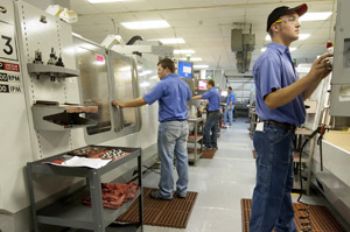
RMI went through a massive upgrade in 2008 and bought eight new machines from Haas (www.haascnc.com): two additional 30,000rev/min mills for its dedicated Peek cutting room; and six 15,000rev/min mills for metal cutting. “We have continued to invest in people and machines since then and now have 32 employees and 15 Haas VMCs — almost all five-axis machines. They are double-shifted five days a week and are available on Saturdays.
“We offer a great service that relies on a combination of strong teamwork, fast turn-round, robust engineering, good quality control, creativity, efficiency and excellent equipment. The worst possible outcome for us would be for one of our parts to fail after surgery, leaving the patient in more pain and having to ‘go back in’. We have never been in that position, but the warning we give to our people by way of motivation is: ‘This goes into a human body; it must not fail’!”
About 80% of RMI’s work involves producing high-precision orthopaedic implants, mainly for spinal surgery; most of the balance involves making the instruments used in that surgery. “We also do hip and knee work, but we specialise in the spinal market because it demands creative solutions and offers very stable growth.”
It is the surgeons who come up with the ideas; they usually see that a certain part will aid a patient’s recovery. The OEMs then develop the ideas and contract RMI to manufacture them.
Mr Langenkamp says: “We don’t own the intellectual property on the devices, but we do own the IP on the manufacturing processes. We do a lot of design innovation at that stage. We also do rapid prototyping on our Haas Mini Mill, particularly where this allows a customer to test a device before submitting it to the FDA for approval. Moreover, time-to-market can be very short. One client came to us on a Thursday evening needing parts for surgery the following week — and didn’t even have a 3-D model. We pulled a couple of ‘late nighters’, and worked the weekend; the parts were implanted in the patient on the Tuesday.”