Bowtech Products was established 22 years ago as an importer of equipment used for underwater applications, but now the company designs and manufactures its own equipment.
Exports currently account for two-thirds of its turnover, which has helped to double the size of the business over the last five years. Indeed, its export performance was one of the reasons for Bowtech winning the Subsea UK Global Export Award 2012, which was sponsored by Scottish Enterprise.
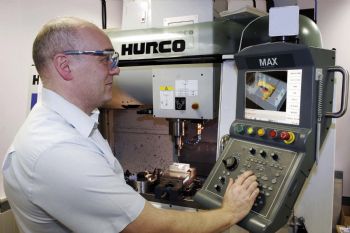
The manufacture of components has historic-ally been sub-contracted but is gradually being brought in-house to control cost and quality, as well as to shorten lead times from weeks to days. Two CNC lathes and a machining centre from High Wycombe-based Hurco (www.hurco.co.uk) underpin mach-ining at Bowtech’s production facility on the Kirkhill Industrial Estate in Dyce, near Aberdeen airport. The typical batch size is 100 parts; small runs and prototypes are now machined more competitively than when
they were put out to external machinists.

Cameras and LED lights are core Bowtech products, particularly those mounted on remote-ly operated underwater vehicles. Business is currently so brisk that, so far, efforts to reduce sub-contracted manufacture have been thwarted, as internal manufacturing capacity has been taken by growth in demand. In response, Bowtech decided to build a new, dedicated machine shop, which will become operational in 2013. Meanwhile, the Kirkhill unit continues to lead the way within the group in bringing machining in-house.
Mould tool manufacture
The main activity of the division is the production of polyurethane joints that connect submerged electric cables. The manufacture of injection mould tools to make the joints is undertaken by a Hurco VM1 vertical machining centre, installed in 2009. Stuart Rowley, cable and mechanical moulding manager at Bowtech, says: “After I have designed the two halves of a tool, production takes two to three days on the Hurco, whereas the lead time was much longer when we had the mould made outside.
“Before we bought the VM1, we looked at a similar machine making mould tools at the Great Yarmouth factory of SEACON (Europe), whose underwater electrical connectors we sell in Scotland. We realised that the WinMax software in the Hurco control was ideal for small-quantity mould production, due to its powerful conversational programming capabilities; it takes next to no time to master. To maximise the control’s effectiveness, we bought Hurco’s 3D Mold package — and practically every other software option.”
It was in 2010 that the success of this first in-house machining venture encouraged Mr Rowley to consider making camera and light housings on-site; these need a lot of drilled
and tapped holes on the ends of round components. A Hurco TMM10 CNC turning centre with a 10in chuck and driven tooling seemed the obvious choice; it is controlled by Windows software so similar to the milling version that Bowtech staff did not even need to go for the training that came with the lathe purchase.
The most recent addition to Bowtech’s machine shop is a Hurco TMX8MY lathe (above). This has an 8in chuck and a Y axis to allow for the off-centre cross-drilling of holes and the milling of flats — operations that are not possible on the TMM10 machine.
The company tends to pick higher-added-value work to turn-mill in quantities up to 100 parts. Larger runs, which can be as high as 1,000 parts, continue to be sub-contracted for the time being. Materials include anodised aluminium and stainless steel — plus titanium alloy for the high-value end of Bowtech’s product range. The accuracies held are typically 0.125mm total, although some O-ring grooves need to be machined to a tolerance of 0.025mm.
Working off-line
Mr Rowley opted to install Hurco’s off-line WinMax programming software on his PC. Itarrived ahead of the VM1 and was a useful facility for self-training. It is now used to review the next program off-line, while a part is being machined on the machining centre or one of the lathes. This approach allows the progress of a live program to be monitored at the machine controls, instead of tying the controls up programming the next cycle in background.
Mr Rowley says: “If more-complex cutter paths are needed for any particular routine, such as engraving our company logo into the curved surface of an injection mould, we use AutoCAD Inventor to create the design and output it as a DXF file that the WinMax control is able to read directly.
“The big advantage of Hurco’s NC Merge capability is that we can program conversationally around the DXF element to generate the complete cycle, without having to use tedious G and M codes. It is surprising how easy it is to do.”
The next step for Bowtech will probably be five-axis machining to address the milling of complex titanium components, which have to be machined from the solid, as castings are very costly. Such work also tends to be expensive if put out to sub-contract manufacture.