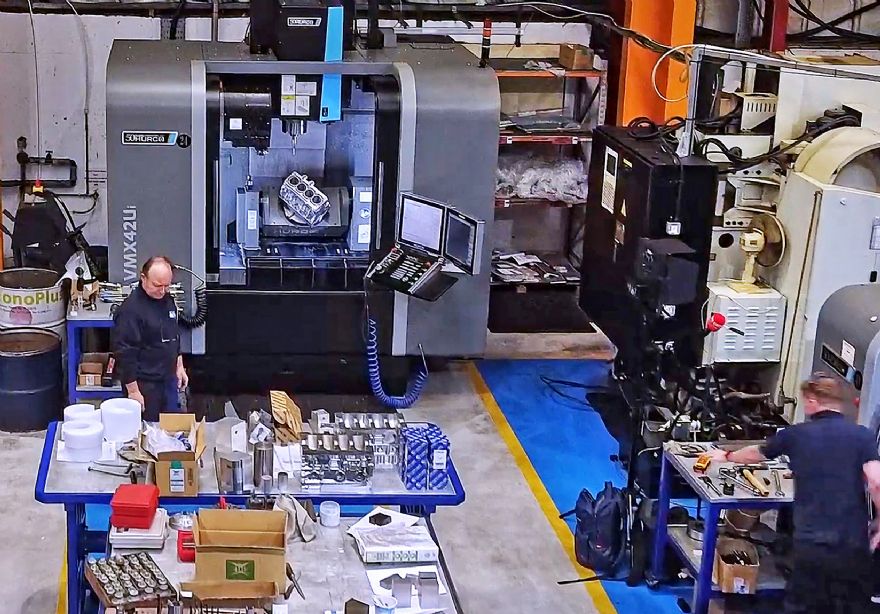
The original engine of the A-series Classic Mini included a 32kg cast iron block. Imagine the improved performance if the latest advances in engine technology were applied today? This is what inspired Smethwick-based sub-contractor
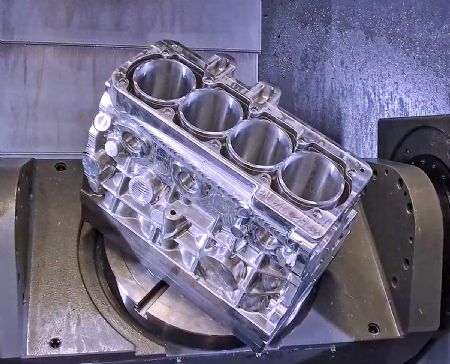
A&M EDM to create its own engine, a road race version with a block machined from solid aluminium weighing just 20.55kg with end caps fitted.
Nearly all of the engine parts are made on Hurco machine tools supplied by High Wycombe-based
Hurco Europe Ltd, of which there are 27 on the shopfloor, including three, four and five-axis vertical machining centres (VMCs) and CNC lathes.
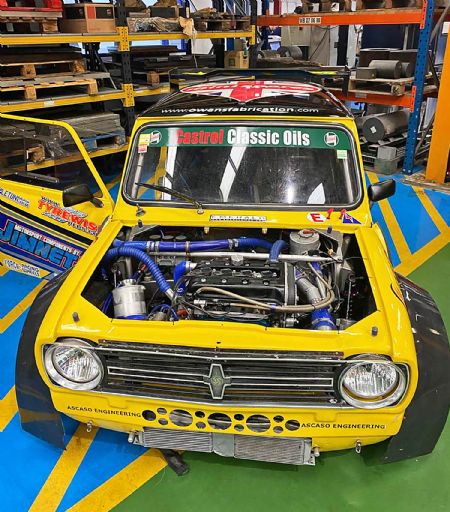
Launched in the first quarter of 2023 and marketed worldwide under the Ascaso brand name, the A+5 1,273cc K16V turbo engine was successfully tested in December 2022 at the Llandow race circuit in South Wales by racing legend Jim Lyons. He originally loaned his Mini to A&M EDM so it could laser-scan and reverse-engineer the body and engine bay, in addition to some of the other legacy engine components.
Mr Lyons said: “It is amazing how different the car felt. The steering was so much sharper with the lighter engine block and the engine just wanted to rev! We were still using the multi-piece development crankshaft, so revs were limited to 7,000rev/min, although the engine has reached 9,250rev/min during testing.” A lap time of 43.04sec was recorded, which is only 0.75sec slower than the lap record.
The project is the brainchild of Gary Surman, previously technical director at A&M EDM, a business that has grown since 2002 from two employees and a rented machine to a headcount today of 70 and annual sales of over £7 million. Managing director Mark Wingfield supported his ambition, believing that that the addition of a proprietary product would enhance the sub-contractor’s portfolio.
Mr Surman built his first Mini engine at the age of 12. Even then he had a vision of building a block with five main bearings rather than three, with two extra columns either side of the central bearing to provide extra support for the crankshaft. The Covid-19 pandemic combined with forward-thinking management at A&M EDM finally gave him the opportunity to realise his dream.
The block is machined on a Hurco VMX42Ui five-axis VMC, while the crankshaft is produced from a solid billet using the swivelling B-axis of a Hurco VMX60SRTi VMC synchronised with the motions of a Kitagawa GT320 rotary fourth-axis table. The initial engine design was for the front-wheel-drive, transverse engine layout of the Mini, but a crankshaft has also been developed for an in-line engine. So, with adapter plates it can be used in sports cars with rear wheel drive, such as the Austin-Healey or MG Midget. There is even the possibility of starting a new race series if the engine is put into track cars.
Mr Surman said: “We have served the Formula One, automotive, marine and aerospace industries for many years and were able to employ those skills to manufacture our own engine. The original had three main bearings but the new version has five, so it can rev at higher speeds up to 10,000rev/min and accept a load in excess of 350bhp.
“Moreover, the accuracy and surface finish we achieve on the Hurco machines are excellent. Roughing speeds are high at 12m/min, while finishing with a ball-end mill is at about 2.5m/min. The programs for machining the block have been linked, so it can be left overnight for unattended machining.”
Ascaso A+5 engines of different capacities have also been developed - 998cc and 1,171cc for both the BMW K16V and 12G940 heads. The future for all of them looks bright, as there are thousands of Mini enthusiasts worldwide. Moreover, the engine’s ability to power rear-wheel-drive cars dramatically extends its potential. It may also have other applications such as for use in boats and it may even have sufficient power-to-weight ratio to be used in light aircraft, subject to testing. Mr Surman already has the next iteration of the Ascaso A+5 firmly in mind.
For further information visit the website:
here