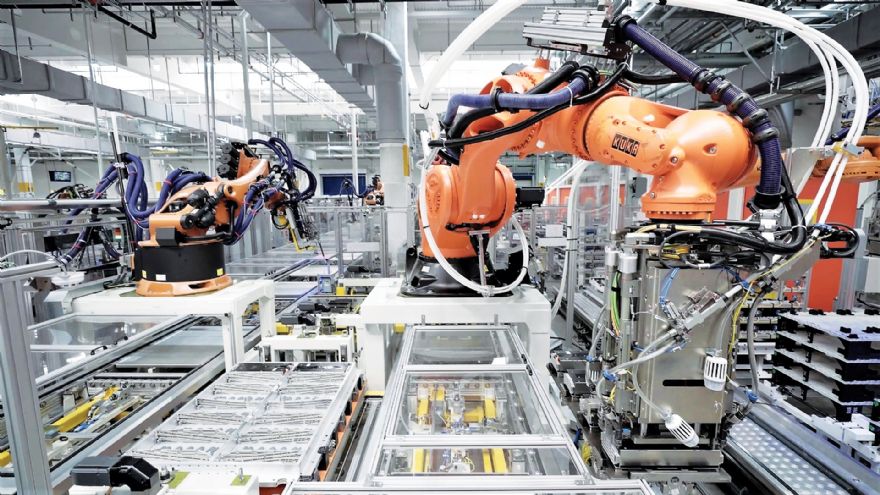
 FAW-Volkswagen
 produces up to 300,000 battery packs per year at its Foshan plant in southern China, where around 100
KUKA robots undertake a variety of tasks in the ‘KUKA assembly plant’, tasks that include welding, gluing, and packaging, among other things. This production facility — a flagship plant for the FAW-Volkswagen Group — is known as the ‘MEB Smart Factory’ and was built specifically to produce the all-electric MEB platform (Modular E-Drive System).
For the
Volkswagen Group (VW), it is a reference factory for electric vehicles (EVs) and a focus for the global automotive industry regarding automation, smart production, and digitalisation. Indeed, the level of automation at the MEB factory is up to 82%, KUKA implemented the assembly line for the battery packs made here.
The production of battery packs is a particularly challenging one, not only for achieving the demanding production steps, high capacity, and system availability, but also for meeting the quality requirements and ensuring the systematic acquisition of all relevant process data; and due to the high importance and safety relevance of battery systems, the traceability of the installed components and the individual production steps is becoming increasingly important. It is in this area that KUKA’s capabilities relating to the ‘digital factory’ provide distinct advantages.
The MEB Smart Factory has incorporated advanced technologies for the entire production line. For example, real-time data and early warning systems throughout the production line ensure that plant performance data can be tracked at any time and from anywhere. In addition, the MEB Smart Factory has a variety of high-end test equipment that can perform 100% testing of air tightness, loading and unloading, and other process-relevant parameters.
This ensures the safety and reliable quality of the battery packs; and by using preventive maintenance, downtime is minimised and maximum OEE (overall equipment effectiveness) can be achieved on the entire production line.
In the factory, welding lines for battery shells are lined up with battery packaging lines and complemented by testing equipment and logistics using automated guided vehicles (AGVs). The KUKA robots allow an annual output of 150,000 battery packs on a single-shift basis; on a double shift, the plant can manage up to 300,000 battery packs per year.