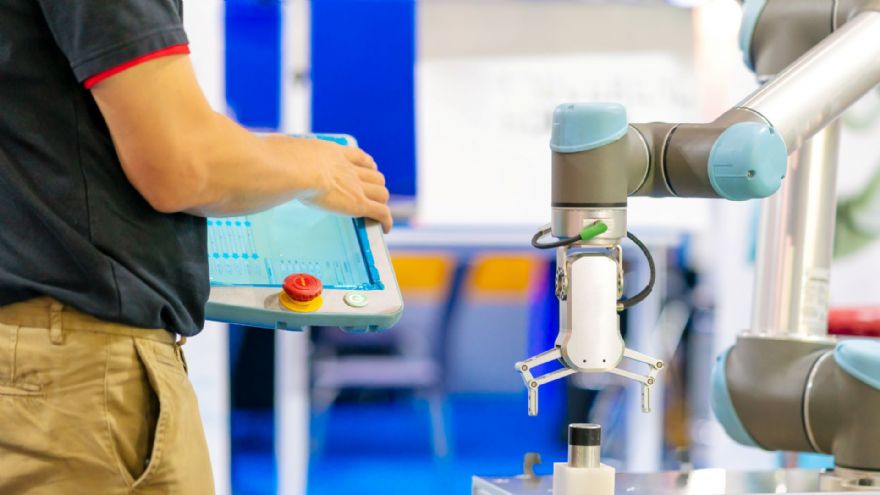
 Cobots have fundamentally reshaped expectations around automation, emerging as a direct response to some of the industry’s most urgent pressures. Persistent labour shortages, rising production demands and the physical limits of traditional factory layouts have made flexibility a priority. Their appeal comes from the combination of simple integration, accessible investment levels and the ability to operate safely. Here, Hakan Aydoğdu, CEO at CNC automation specialist Tezmaksan Robot Technologies, reflects on how collaborative technologies are redefining automation.
The latest World Robotics 2025 report underscores just how rapidly this shift towards automation is accelerating. Industrial robot installations reached 542,076 units in 2024, more than double the figure seen a decade earlier. It marks the fourth consecutive year that annual installations surpassed the half-million threshold. Asia continues to dominate with nearly three-quarters of all new deployments, while Europe and the Americas represent far smaller shares. These numbers reveal not only the speed of adoption but also the global imbalance in automation readiness.
Recent research from
Make UK highlights that around 36% of manufacturing vacancies are hard to fill due to candidates lacking the right skills, qualifications or experience. Collaborative robots are playing an increasingly vital role in addressing this gap. By taking on repetitive, physically demanding or high-risk tasks, cobots help manufacturers maintain production levels even amid workforce shortages.
Cobots consistency support higher output and more reliable quality, while freeing human workers to focus on complex or value-adding tasks. They also contribute to better workplace wellbeing by reducing strain and injury, and their straightforward programming makes automation achievable without long lead times or extensive training. For many companies, this combination accelerates the path to a measurable return on investment. In the manufacturing sector, cobots are increasingly utilised to optimise assembly lines and improve operational workflows. Studies indicate that cobots can significantly improve productivity by automating repetitive tasks while allowing human workers to focus on more complex activities that require cognitive skills.
Regulatory frameworks are evolving in parallel with this technological momentum. The EU Machinery Regulation 2023/1230, which replaces the previous Machinery Directive, was adopted in 2023 and will apply fully from January 2027. It introduces a more robust approach to safety, responsibility and cybersecurity for advanced machinery and collaborative systems. The new requirements push manufacturers toward clearer accountability and more rigorous conformity processes, signaling that compliance and safer integration will become a defining factor in automation deployment over the next few years.
For engineers, this has direct implications for the design, deployment and validation of collaborative robot systems. In logistics environments, cobots are increasingly used for palletising, order picking and intralogistics material handling, where integrated vision systems, force sensors and safety-rated scanners enable close human–robot collaboration without traditional safety cages. In automotive manufacturing, cobots support precision assembly, screwdriving, quality inspection and machine tending, improving cycle time consistency while reducing ergonomic strain on operators.
Best practices for seamless integration include conducting task-specific risk assessments in line with ISO 12100 and ISO/TS 15066, implementing safety-rated monitored stop and speed-and-separation monitoring, and ensuring robust cybersecurity controls for connected robotic cells. Engineers are also advised to prioritise modular system architectures, standardised industrial communication protocols (such as PROFINET or EtherCAT), and digital simulation tools to validate layouts and workflows before physical deployment.
Plenty of manufacturing environments are ageing or built around legacy systems that weren’t designed for robotics. Tight floor plans, outdated infrastructure or patchy connectivity can all complicate integration. When new technology meets older equipment, the process can become costly or time-consuming if the two don’t align smoothly. A robot’s capabilities alone don’t determine whether collaborative automation works. Setting up and configuring robotic systems, integrating software and keeping everything maintained can push a team beyond its current expertise. Upfront costs, from the equipment itself to facility modifications and staff training, can seem steep, especially in today’s economic environment.
Traditional robots, usually built for fixed, repetitive tasks, often need extensive reprogramming whenever products or layouts change, causing downtime that can quickly erode their overall benefit. To address these constraints, manufacturers are increasingly adopting more flexible automation approaches that prioritise rapid deployment, reconfigurability and scalable investment, particularly for small and mid-sized operations.
For example, CubeBOX EcoLEAN-V1 and V2 enable systems to be repositioned and adapted as workflows evolve. This flexibility allows manufacturers to scale automation incrementally without locking production into fixed layouts. This reflects a broader shift toward agile automation, solutions designed to adapt alongside changing production requirements. EcoLEAN is available in multiple configurations to support different payloads, part sizes and space constraints, enabling deployment across a range of manufacturing environments.
A 2025 Deloitte survey of 600 manufacturing executives found that 80 per cent plan to invest 20% or more of their improvement budgets in smart manufacturing initiatives this year, with a focus on foundational tools and technologies. This level of commitment signals a clear industry shift: Manufacturers are no longer viewing digitalisation and automation as optional upgrades, but as essential capabilities that will define competitiveness in the years ahead. While collaborative technology drives this transformation, it is flexibility, mobility and financial accessibility that will ultimately reshape how manufacturing operates and who has access to the benefits of automation.