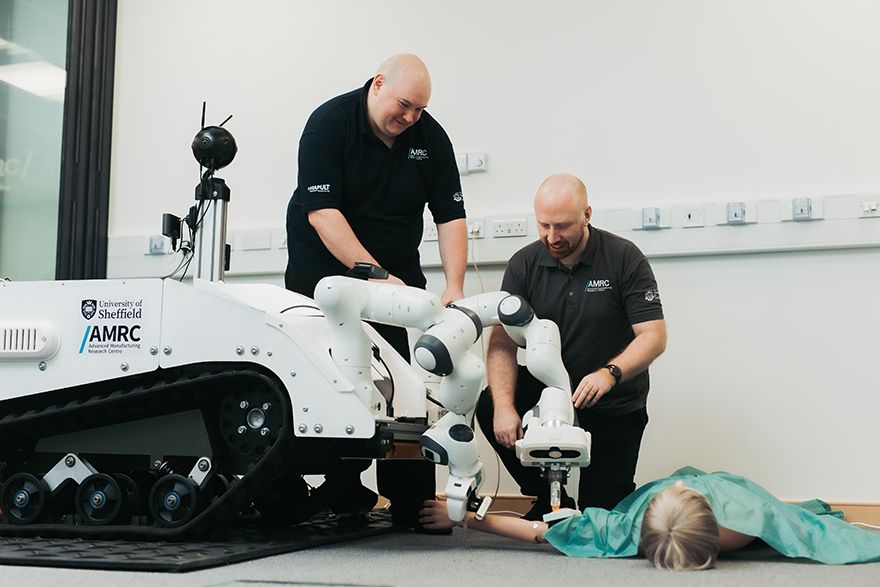
 Ryan Swain (left), technical lead, pictured with Rob Stacey, senior project engineer, both part of the design and prototyping group at the University of Sheffield AMRC — members of the MediTel project team
Game-changing robotics technology to provide remote medical treatment to casualties in high-risk emergency environments has been developed by researchers at the
University of Sheffield. Using medical telexistence (
MediTel) technology, researchers from the university’s
Advanced Manufacturing Research Centre (AMRC), Sheffield Robotics and Department of Automatic Control and Systems Engineering, have successfully created a mobile, robotic-controlled uncrewed ground vehicle (UGV), which utilises virtual reality (VR), to enable medics and operators to safely assess critical casualties in hazardous environments, allowing them to perform a remote triage.
The first-of-its-kind, fully integrated medical telexistence solution was developed in just nine months. It features two robotic arms which can remotely operate medical tools to perform a critical initial assessment of a casualty within 20min, including: temperature, blood pressure and heart rate checks; carry out a palpation of the abdomen and administer pain relief through an auto-injector — all while streaming real-time data to the remote operator.
The project was led by David King, head of digital design at the AMRC and Sanja Dogramadzi, professor of medical robotics and intelligent health technologies at the Department of Automatic Control and Systems Engineering and director of
Sheffield Robotics.
Mr King said: “Our MediTel project has demonstrated game-changing medical telexistence technology that has the potential to save lives and provide remote assessment and treatment of casualties in high-risk environments such as humanitarian disasters. Developing and field testing a ‘state of the art’, complex system such as MediTel in just nine months has been an incredible achievement and a testament to the skills and capabilities of the entire project team.”
Mr King said the project enabled the team to develop a complete solution to perform a triage of casualties in hazardous environments. He added: “MediTel combined existing medical devices with advanced robotics systems to develop a platform capable of allowing a remote operator to navigate through potentially difficult terrain and provide critical diagnoses of high-risk casualties.”
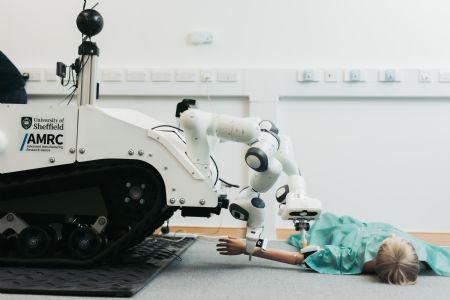 Pictured right: The prototype MediTel robot
Professor Dogramadzi said: “This project has allowed us the opportunity to develop a platform that could be used by multiple emergency response services. It now serves us with the basis for our research to be extended and look into enabling resilient autonomy and integrating other sensing modalities to assist patient triage in other remote settings.”
MediTel was one of three novel telexistence technologies funded through a two-phase £2.3 million innovation competition run by the Defence and Security Accelerator (DASA), on behalf of joint funders, the Defence Science and Technology Laboratory (Dstl) and the Nuclear Decommissioning Authority (NDA).
Dr Nicky Armstrong, technical lead at Dstl, said: “The prototype technologies developed under the Dstl Telexistence project have enabled us to demonstrate the art of the possible to end users, so that we can better understand where telexistence could add value to defence and security environments.”
As part of the project work, the AMRC used its knowledge to design and create a prototype of the UGV and integrated the overall MediTel system, while the Department of Automatic Control and Systems Engineering led on the development of the robotics controls. Extensive laboratory and field testing was also carried out and proved the UGV could assess and triage a casualty successfully. The team is now looking to build on the project’s success by seeking further funding and partners.
Further information on the AMRC’s design and prototyping capabilities and how it could help companies is available
here.