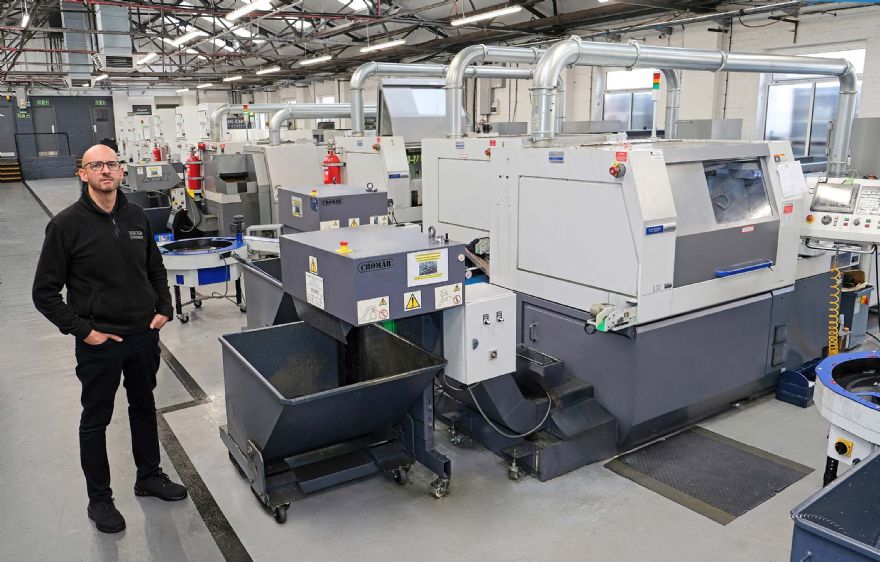
 Yian Stavrou standing by some of the 14 Citizen Cincom sliding-head lathes in Sub-CNC’s factory in Luton
The decision to set up a turned parts sub-contracting business at the start of the worst economic crisis in living memory has paid off for Yian Stavrou and George Dingley, joint owners of Luton-based
Sub-CNC Precision. Supporting their successful evolution from earning a few thousand pounds a month in 2008 to turning over a predicted £3 million in the company’s current financial year has been, from the very beginning, continued investment in twin-spindle, multi-axis, bar-fed lathes supplied by
Citizen Machinery UK.
Over the years, the ISO 9001:2015-accredited and JOSCAR-registered sub-contractor has bought 25 of them, part-exchanging a few along the way, to leave 21 on the shopfloor as of November 2025. Two-thirds are Cincom sliding-head models for producing parts from 0.5 to 38mm in diameter and the remainder are Miyano fixed-head turning centres. Furthermore, many of the lathes run 24/7, lights-out from 6pm to 7am.
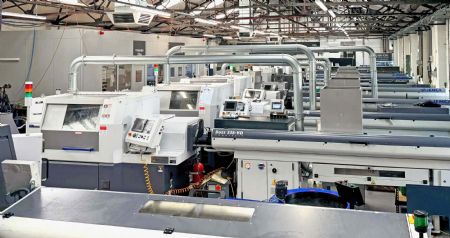 Pictured left: Another view of the Cincom sliding-head lathes on the shopfloor
In total, there are 27 CNC machines on the shopfloor, including another fixed-head turning centre, three vertical machining centres with a fourth axis, a CNC cylindrical grinding machine and a 3-D printer. The list of industries served is long, including aerospace and defence, automotive and motorsport, telecommunications, sensors, energy and renewables, hydraulics, medical and instrumentation.
The introduction of Citizen’s proprietary LFV (low frequency vibration) chip-breaking software in the Cincom control massively assisted unattended machining, according to Mr Stavrou. He said: “In 2017, we installed one of the first LFV machines in the country, a 20mm bar capacity L20-VIII which arrived in the April, followed at the end of that year by a 12mm capacity L12-VII.
“It was immediately clear that their ability to break what would normally be stringy swarf, which would necessitate stopping the machines to clear it away manually, into short chips meant we could leave them unattended to produce components, even from difficult-to-machine materials, knowing that we would arrive in the morning to a bin full of perfect parts. It is the only way to remain competitive in the face of competition from low-wage countries.”
LFV a prerequisite on all new machinesThe two lathes were immediately deployed onto turn-milling parts from copper and phosphor bronze, during which LFV’s effectiveness at chip-breaking the long, continuous coils of swarf was especially apparent. Monel, Inconel, titanium alloys and other exotics including for submarine component manufacture were similarly machined reliably. Encouraged by this initial success, the owners have made sure that no new Cincom since then has entered their factory without LFV. Currently, more than half of the sliding-head lathes on the shopfloor are equipped with the function.
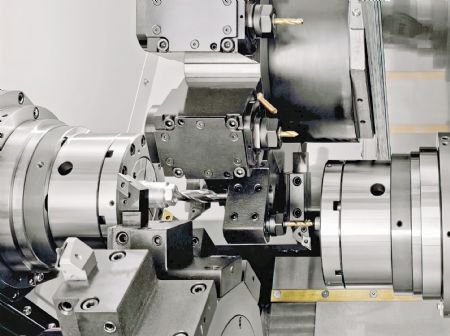 Pictured right: Turn-milling in progress on Sub-CNC’s latest Miyano BNE-51MSY fixed-head lathe
When machining copper, for example, LFV is switched on for most of the time to prevent ribbons of swarf from being generated. However, it is also useful for promoting chip-breaking when turning other, less problematic malleable materials such as stainless steel and aluminium, as well as plastics including nylon, PEEK, acetal, POM, PTFE and ABS.
The big advantage of the function is that it can be programmed using G-codes to switch on and off during a cycle, added to which it also has different modes to adjust the size of the chips. To maximise output by avoiding unnecessary periods of slightly reduced productivity while the tool leaves the surface of the component to initiate chip breakage, the function is disabled for parts of the cycle where enhanced chip-breaking is not required.
Mr Dingley mentioned other facets of the Cincom offering that helps Sub-CNC’s business. One is 140-bar high-pressure coolant delivery to the cutting zone, which further assists chip-breaking, especially during parting-off. Another is the removable guide bush, which takes about 30min to swap in and out. When it is not in place, economical use may be made of lower quality, unground bar that would seize in the guide bush, while bar remnant length is reduced, resulting in further savings. The set-up is ideal for producing parts whose length is less than 2.5-times the diameter, as radial flexure due to the force of cutting tool infeed is not significant, even at the unsupported end of such relatively short components.
Complex turn-milled componentsAs to the fixed-head Miyano lathes, which produce parts from bar ranging from 8 to 65mm in diameter, or from billet up to 200mm diameter, they started arriving at the sub-contractor’s factory in 2012 in the guise of a pair of 42mm bar capacity BNA-42MSY turning centres. At the time, they assisted in particular with the production of complex turn-milled components for the oil and gas sector.
Latest to be installed, in July 2025 alongside a new Cincom L20-XLFV, was a Miyano BNE-51MSY to provide more capacity for fixed-head turning. Three new lathes from Citizen including these and a third-generation A20-VII arrived on the shopfloor in the first seven months of the year.
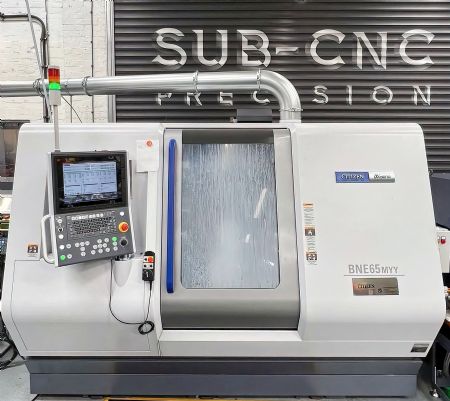 Pictured left: the largest-capacity Miyano at Sub-CNC and the only one with two Y-axis turrets
The BNE-51MSY was preceded in 2022 by a BNE-65MYY, extending the diameter of component that can be produced in the Luton factory to 65mm. The lathe has Y-axis movement on both tool turrets, which at the time enabled efficient production of an aircraft component in one hit in a 7min cycle, using superimposed machining with three tools in cut simultaneously. The reliability of the process even allowed unattended running overnight. The essentially prismatically-shaped, L168 aerospace aluminium part was previously milled in three separate operations on machining centres by another sub-contractor in a process that took much longer.
Employing 22 people, including engineers whose skills have been honed as a result of the firm’s internal apprenticeship scheme and association with the local Dunstable Technical College, Sub-CNC also offers sub-assembly as an added-value service for customers. With the aid of Fitfactory production control and materials requirement planning software, a variety of logistics options is offered to integrate with customers’ inventory and production schedules. They encompass consignment stocking of manufactured components and assemblies, just-in-time delivery including kanban, and spot order fulfilment.
Quality assuranceCentral to the sub-contractor’s operation is a well-equipped inspection room, emphasising the company’s commitment to delivering high-quality components. Quality assurance begins before production with a thorough review of technical drawings and customer specifications and continues throughout the contract, with first-off and in-process inspections carried out by operators and the quality team using touch-probe and non-contact optical measuring equipment. Everything is traceable and documented, from raw material receipt through to final despatch.
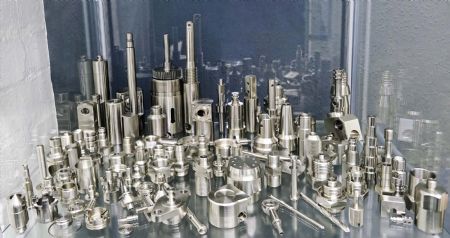 Pictured right: A selection of components that have been turned and milled by Sub-CNC on the 21 sliding- and fixed-head lathes supplied by Citizen Machinery UK
A selection of components that have been turned and milled by Sub-CNC on the 21 sliding- and fixed-head lathes supplied by Citizen Machinery UK.What characterises Sub-CNC’s business above all else, however, is its specialisation in high-volume turned parts production. George highlighted that the subcontractor has recently won three additional, long-running contracts. One involves machining 20,000 stainless steel automotive components per week. Complex sensor parts, also in stainless steel for a customer in the utilities sector, are required in quantities of 3,000 per week. Five different brass components for an oil and gas industry customer are currently running at 10,000 per month.
At the other end of the scale, the sub-contractor regularly undertakes design and prototyping for customers, followed by short production runs of, say, 10- to 20-off, even on a sliding-head lathe. Often, this type of project turns into a long-running contract later on.
In conclusion, Mr Stavrou said: “George and I are both time-served mechanical engineers with early experience operating Cincom machines at various sub-contract machining companies. We were always impressed by their performance, so when we set up our own business, choosing a Citizen lathe was the natural decision.”
“It proved to be exactly the right choice. The fact is, if you set up a Cincom or Miyano correctly, it is practically impossible to end up with a bad part. Without any adjustment, they just carry on producing components hour after hour, to single-figure micron tolerances if necessary, until the bar magazine runs out of stock.”