 Metamorphic AM
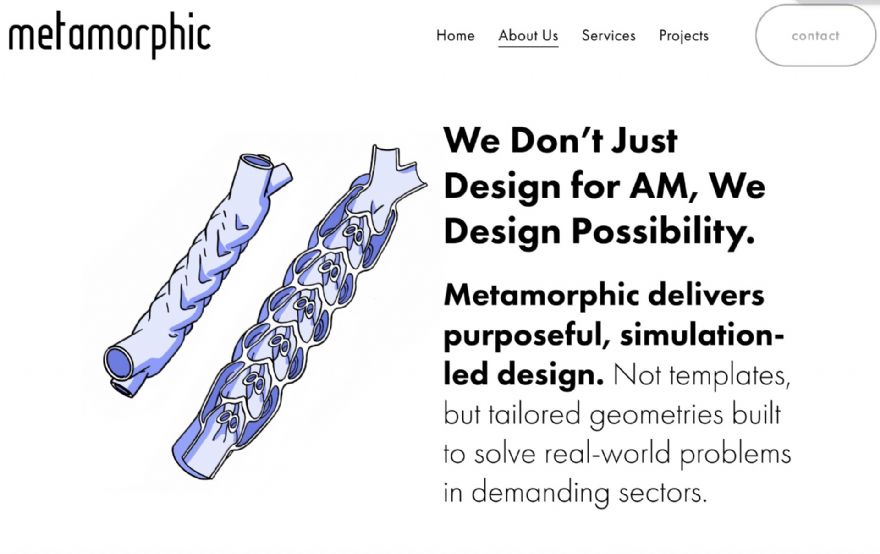
, a UK-based design and engineering consultancy specialising in advanced design for additive manufacturing (DfAM), has launched a new website that articulates its philosophy — ‘additive manufacturing (AM) succeeds not through automation alone, but through intelligent, intent-driven design‘.
Since its founding, the company has been trusted to deliver highly complex, high-value engineering programmes across emerging sectors such as quantum technologies, fusion energy, advanced communications, medical devices, and wearables, leading over £8 million in R&D projects since 2021. While that work continues, what is new is how accessible that expertise has become.
Laurence Coles, co-founder of Metamorphic AM, said: “Our new website is about clarity. There is a lot of noise in DfAM right now, software promises, automated optimisation, ‘one-click’ solutions. We wanted to clearly state what we believe, that real performance comes from understanding function first, then building geometry to serve it.”
At the heart of the new site is Metamorphic’s expanded Rapid Geometry Review service. Designed to bring senior-level DfAM insight earlier into development cycles, the review allows teams to assess printability, functional performance, manufacturability, and missed geometric opportunities before committing to costly iterations or builds.
Avoid dead endsMetamorphic’s co-founder Manolis Papastavrou said: “Historically, we have been brought in when problems were already very complex. What we’re doing now is opening the door earlier, helping teams avoid dead ends before they’ve invested time and money in the wrong geometry — it is about smarter decisions, sooner.”
The site also makes a clear distinction between Metamorphic’s approach and the growing reliance on generic optimisation tools. Rather than treating DfAM as a set of presets — lattices, topology optimisation, automated workflows — Metamorphic positions geometry as an outcome of engineering intent, informed by simulation, material behaviour, and manufacturing realities.
Mr Papastavrou concluded: “Tools matter. Of course, we use them, but they don’t replace engineering judgement. Our work has always been about using computation to amplify insight, and expand geometric freedom, not automate thinking.”
With its new platform, Metamorphic invites a broader range of innovators (from startups to established manufacturers) to engage with DfAM as a strategic capability rather than a technical after thought.