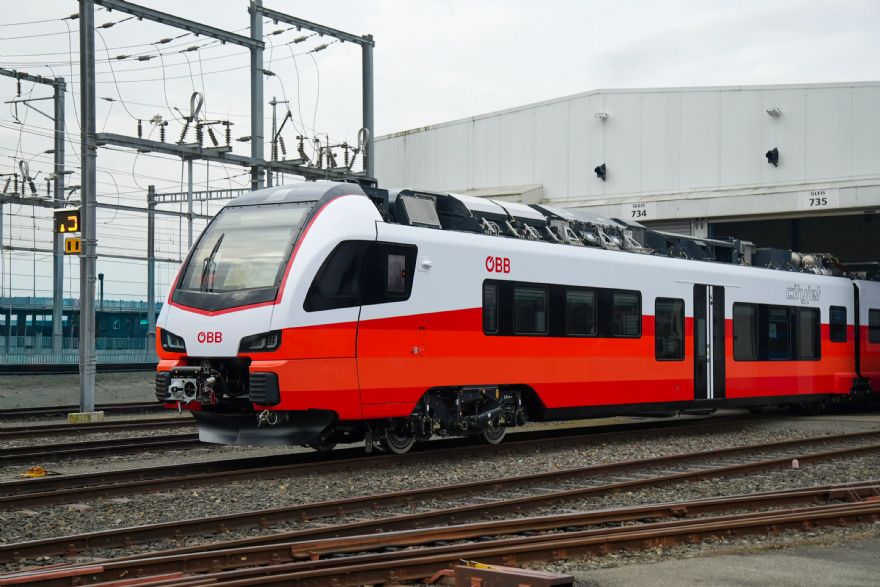
The Austrian Federal Railways (ÖBB), which is continuing to invest in emission-free regional transport, has ordered seven additional Flirt Akku units from
www.stadlerrail.com/en Stadler, a Swiss manufacturer of railway rolling stock that operates globally. The battery‑powered Flirt Akku trains will be manufactured in Bussnang and will save around 500,000 litres of diesel per year. Delivery is planned for 2028, and they will enable emission-free operation even on non-electrified lines. The new battery-electric multiple units (EMUs) will gradually replace existing diesel trains in Lower Austria.
Ansgar Brockmeyer, Stadler’s head of marketing and sales, said: “The Flirt Akku shows how modern technology and sustainable mobility go hand in hand. We are very pleased with the trust placed in us by ÖBB and that we can continue our successful collaboration. In July 2023, ÖBB and Stadler signed a framework agreement for up to 120 Flirt Akku units. The first call-off included 16 vehicles for the Kamptalbahn. The second call-off is now taking place.”
Mr Brockmeyer said Stadler has also been awarded a contract to supply Flirt trains for Greater Poland. This is for the delivery of up to 20 Flirt EMUs, with the vehicles being built in Poland. The contract, worth about 263 million euros, covers the delivery of 10 five-car Flirt EMUs, with an option for an additional 10 vehicles. The first trains are scheduled to enter service at the beginning of 2028.
Rados³aw Banach, president of Stadler Polska, said: “More than 3,000 Flirt units have been sold in 24 countries worldwide, and in our Siedlce plant alone we have manufactured over 650 Flirt vehicles for operators from 18 countries. Of these 650, 127 are operating on Polish tracks.
“Stadler Polska engineers, including our team in Poznañ, will be responsible for designing the vehicles for Greater Poland, creating tangible added value in the region. Our local engineering team currently consists of 100 specialists, half of whom work in Poznañ. This year, we plan to recruit an additional 20 engineers.”
Stadler has been present in Poland since 2006 and has consistently expanded its operations by investing in local production, service facilities, and engineering capabilities. Today, Stadler employs more than 2,000 people in Poland across three production plants (Siedlce, Œroda Wielkopolska, and Bia³ystok), engineering offices in Poznañ, Siedlce, and Warsaw, and service centres in £ódŸ and Sochaczew.