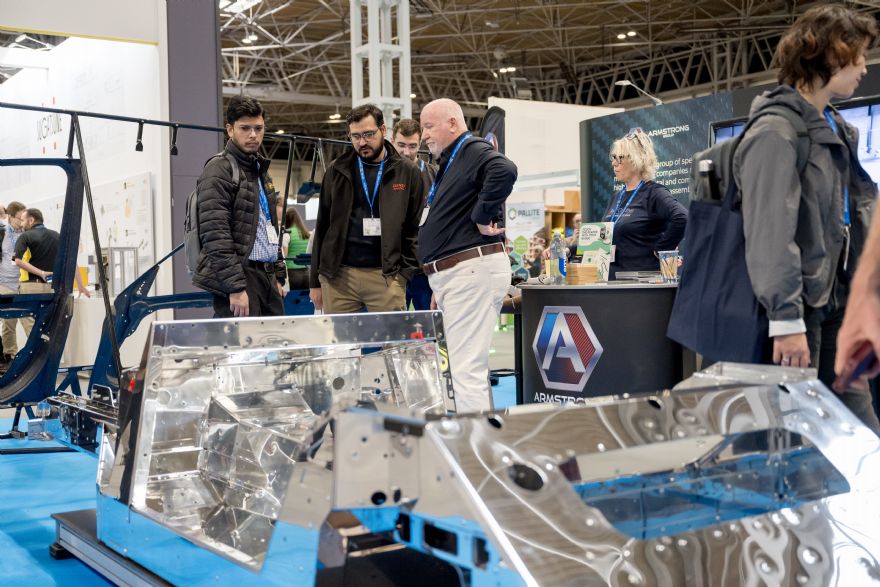
 The Advanced Engineering Show is increasingly being used by the rail sector as a place to access proven technologies
The UK rail industry has reached a pivotal moment as it balances ambitious plans for high‑speed routes and improved regional connectivity with long‑standing structural and delivery challenges. Industry leaders argue that the issue is no longer whether rail can support economic growth and decarbonisation, but whether it can organise itself, technically, institutionally and financially to deliver transformation at the required pace and scale.
Recent industry discussions, including
Rail Technology Magazine’s ‘Tracks to Tomorrow: Rebuilding Rail for the 21st Century’ webinar, have highlighted both the opportunity ahead and the barriers that remain. From an advanced engineering and manufacturing perspective, one of the most striking tensions in the UK rail industry is the contrast between its long innovation history and its difficulty in scaling new technologies across the system.
Toufic Machnouk, managing director at
GBRX, the UK’s the strategic innovation body for railways, said: “Rail is a 200‑year story of invention and innovation. We are custodians of that legacy. But over the last two decades, it has been notably difficult to deliver strategic technologies that change how the whole system works. A highly fragmented industry, a web of well‑intentioned barriers and a shortage of dedicated capability make it almost impossible to simply ‘demand’ innovation. We have to build the pathways and the skills deliberately if we want the system to change.”
Initiatives such as GBRX’s sector‑wide AI action plan, AI incubator and a 10‑year data and AI apprenticeship programme are increasingly cited as examples of the kind of long‑term, system‑level capability building required if rail is to modernise alongside other high‑value industries. Modernising rail infrastructure while keeping services operational is no longer viewed as a purely engineering challenge. Instead, it is increasingly linked to housing delivery, freight capacity, climate resilience and regional economic growth.
Rebecca Rathore of
Network Rail commented: “The railway is not just an infrastructure asset. Stations are civic places for their local communities, and rail should be the backbone of a multimodal network, not a standalone system.” That shift in thinking places greater emphasis on designing infrastructure, stations and services around whole journeys, rather than treating rail in isolation from other modes of transport and regional development plans.
Collaborative platformsRail is not alone in facing capacity constraints, decarbonisation pressures, cost inflation, skills shortages and regulatory complexity. Aerospace, automotive, energy, defence and other advanced manufacturing sectors are grappling with similar issues but many have already built collaborative platforms to accelerate solutions. This is where cross‑sector engagement is gaining traction. The
Advanced Engineering, Show, which brings together aerospace, automotive, defence, energy, marine, medical and space industries, is increasingly being used by the rail sector as a place to access proven technologies and delivery approaches from beyond its traditional supply base.
Over the past three years, the
Railway Industry Association (RIA) has played a key role in anchoring the rail community within this environment, connecting infrastructure owners, Tier 1 suppliers and technology‑focused SMEs.
Simon Farnfield, head of the UK manufacturing cluster at
Easyfairs, organisers of
Advanced Engineering said: “With rail, we are seeing a convergence of pressures that will be very familiar to other sectors: rising expectations, tight budgets and a need to deliver more capacity and better performance, faster.
“The good news is that many of the solutions, whether in modular build, robotics, digital twins or asset intelligence, already exist.
Advanced Engineering provides a space where rail stakeholders can engage with those capabilities and explore how they can be deployed in a rail context.”
The event already attracts senior engineers and decision‑makers from across the rail ecosystem, including organisations such as Siemens Mobility, Network Rail and Hitachi Rail Europe. As participation grows, so does the opportunity for collaboration between infrastructure owners, rolling stock manufacturers, Tier 1 contractors and innovative SMEs.
By bringing together industrial leaders, engineers and technology providers, platforms such as Advanced Engineering are helping ensure that high‑level rail ambitions translate into real‑world performance gains for passengers, freight operators and regional economies.
Advanced Engineering returns to the NEC, Birmingham, on 4-5 November 2026.