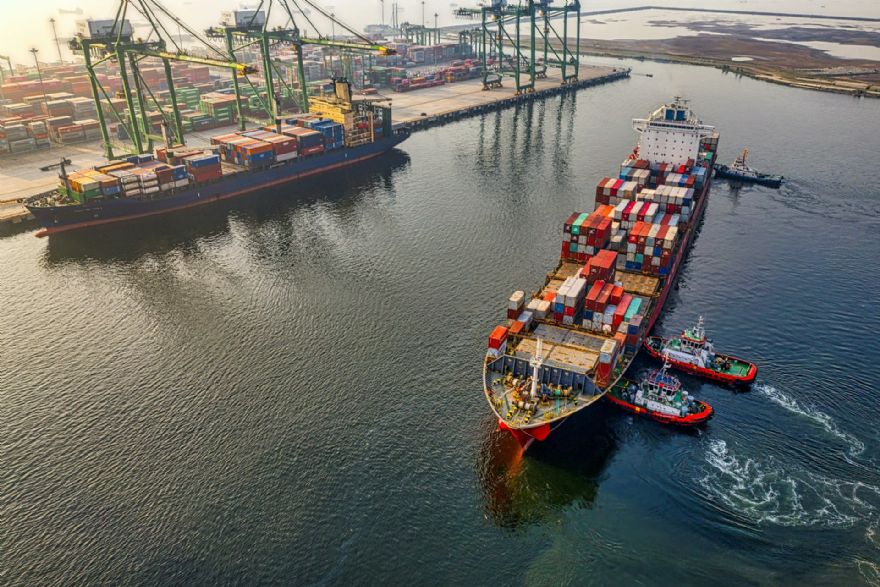
 Photo by William William on Unsplash.com
In today’s global economy, businesses are more connected than ever—opening vast opportunities but also exposing themselves to new and significant risks. From sudden economic shifts and intricate regulations to unexpected disruptions, companies now need deeper foresight and greater adaptability than conventional methods provide. At the heart of this challenge lies a preeminent priority — building a supply chain that can withstand the pressures of an uncertain world.
The headlines of recent years tell a clear and urgent story — our global supply chains are increasingly vulnerable. This was laid bare during the pandemic, when hospitals scrambled for basic protective gear. It was underscored again in April 2024, when a major earthquake in Taiwan forced the evacuation of TSMC, the company that fabricates roughly 90% of the world’s most advanced semiconductors, triggering global shortages.
Furthermore, according to a sobering new survey from Maersk, this era of disruption is far from over. Four out of five European companies expect supply chain shocks to continue through 2027, with more than 78% bracing for direct impacts from geopolitics, shifting trade rules, and tariffs. For nearly half, the broader political climate is a major concern, while a full 80% report that current disruptions are already hampering their growth.
While the challenges are real, they are not insurmountable. Building a truly resilient supply chain may seem daunting, particularly when traditional logistics models are conservative by nature, and shifting a company’s focus from simple efficiency to continuity and security requires a fundamental change in mindset. Yet around the globe, leading companies are proving it can be done — and the rewards extend far beyond their own operations. By strengthening their supply chains, these businesses not only solve internal vulnerabilities but also deliver new benefits to their clients: greater reliability, consistent access to products, and the confidence that comes from a secure and adaptable partnership.
Medtronic’s prescription for a resilient supply chainFor global medical technology designer and manufacturer
Medtronic, the Covid-19 pandemic served as a catalyst for change. The crisis did more than disrupt global logistics; it exposed vulnerability within the medical device industry itself. In an era defined by trade tensions, geopolitical uncertainty, and accelerating global healthcare demands, a fragmented and reactive supply chain was no longer just an operational inefficiency but a direct risk to patient care.
Medtronic learned this lesson the hard way. The company's supply chain and operations were historically decentralised, spread across four distinct manufacturing teams and nine separate supply chain organisations. This structure led to siloed data, misaligned priorities, and an inability to accurately predict or balance supply with demand. When pandemic-driven disruptions unleashed chaos across the globe, this lack of cohesion caused failures at multiple manufacturing sites. The repercussions extended far beyond internal metrics, affecting Medtronic’s most important stakeholders: the hospitals and clinicians who depend on its equipment, and ultimately, the patients awaiting treatment.
To tackle this fragmented system, Medtronic embarked on a radical consolidation, merging its four manufacturing divisions and nine supply chain organisations into single, unified entities with artificial intelligence as a cornerstone of the new strategy. Partnering with EY and its technology allies, Blue Yonder and Snowflake, the company built a centralised data lake that became a single source for all 45 global manufacturing sites.
This new alignment allowed Medtronic to route 90% of its demand planning through an integrated system, achieving a 15% improvement in forecast accuracy. In turn, the newly gained predictive power proved essential for competitive survival in a volatile trade environment, safeguarding margins and market position, and served Medtronic’s core mission — by ensuring a reliable flow of vital medical technology, this resilient supply chain ultimately delivered better health outcomes for patients worldwide.
Resilience through industrial mastery and sovereign innovation In the highly secure world of fiduciary printing, supply-chain resilience is not merely an operational concern; it is a prerequisite for trust. For central banks, the integrity of a banknote depends as much on the robustness of its production chain as on the sophistication of its security features. Oberthur Fiduciaire, the France-based security printer, has built its industrial model around the close control of critical stages of banknote production, while remaining fully engaged in a competitive and technologically demanding global market.
Unlike many industrial sectors, fiduciary printing allows little room for substitution or compromise. Banknote paper, inks, security threads and optical features are highly specialised components, and any weakness in their supply can have direct consequences. In response, Oberthur Fiduciaire has progressively strengthened its control over key segments of its value chain, reducing exposure to capacity constraints and ensuring a high level of delivery reliability in a context of sustained global demand.
This approach has included the acquisition of VHP Security Paper, the Dutch specialist in banknote paper. More recently, the company took a majority stake in Swedish micro-optics specialist Rolling Optics, integrating advanced visual security technologies and further reinforcing its innovation capabilities.
For
Thomas Savare, chairman of Oberthur Fiduciaire, this degree of integration is not about isolation, but about long-term commitment and reliability: “We control almost the entire technical and logistical chain. From paper production to printing—including the design of the most advanced security features—we are able to deliver every stage of the process for our clients.”
Beyond supply-chain security, this industrial mastery underpins a sustained investment in research and development. In a sector where the fight against counterfeiting depends on technological leadership and the protection of intellectual property, Oberthur Fiduciaire relies on specialised R&D teams, notably in France and Sweden, capable of delivering increasingly sophisticated security features — both for its own banknote contracts and, where appropriate, to complement notes printed by third parties.
Oberthur Fiduciaire’s resilience therefore extends beyond risk mitigation alone. It is rooted in a combination of industrial foresight, continuous innovation and trusted long-term relationships with central banks. In an environment where banknotes remain not only a means of payment but also a symbol of monetary sovereignty and public trust, this integrated approach transforms supply-chain control into a tangible commitment to clients.
Sandvik's engineering of precision risk analysis Much like our previous example,
Sandvik — the Swedish engineering leader in manufacturing tools and metal cutting — recogniaes that tighter supply chain control and risk mitigation are essential for maintaining high product performance. The company’s primary vulnerability lay in the delivery of metal powder, a raw material vital to its high-performance tools.
Securing a reliable supply of this specialised material was a core operational challenge that directly impacted Sandvik’s ability to meet client demands. This challenge is intrinsic to the nature of the product: much like high-security banknotes, Sandvik’s cutting tools are not mere commodities. Their superior quality, prized for precision and durability, depends on a high-stakes supply chain where consistency is paramount and suitable substitutes are rare.
A supply chain analysis revealed critical vulnerabilities. The company was over-reliant on a single supplier for its metal powder while also exposed to potential disruptions further "downstream" in the logistics chain—a dual risk that could halt production of its signature products. To understand the danger better, the company decided to put a clear financial value on its supply chain risks, empowering its risk management team to justify necessary insurance and build a business case for specific mitigation investments.
By transforming abstract risk into a measurable cost of inaction, Sandvik created a clear roadmap for resilience spending. In turn, this further enabled internal traction needed to make proportional, confidence-backed investments across the entire supply network, and gave Sandvik’s clients the crucial assurance that the premium tools they rely on are backed by a resilient and secure production chain.
Sandvik’s risk quantification, in common with Medtronic’s technical solutions and the vertical integration of Oberthur Fiduciaire, underscores the same powerful logic: building resilience is all about protecting the promise made to the client. For each company, the journey toward a future-ready supply chain was not merely an internal project to boost margins or streamline logistics.
It was a commitment to guarantee product quality, ensure reliable delivery, and uphold their reputation—no matter what disruptions arise. In an unpredictable world, this operational foresight is the new cornerstone of client service. It transforms the supply chain from a cost centre into a source of competitive confidence, ensuring that companies can serve their customers consistently and deliver on their core value, today and in the years to come.