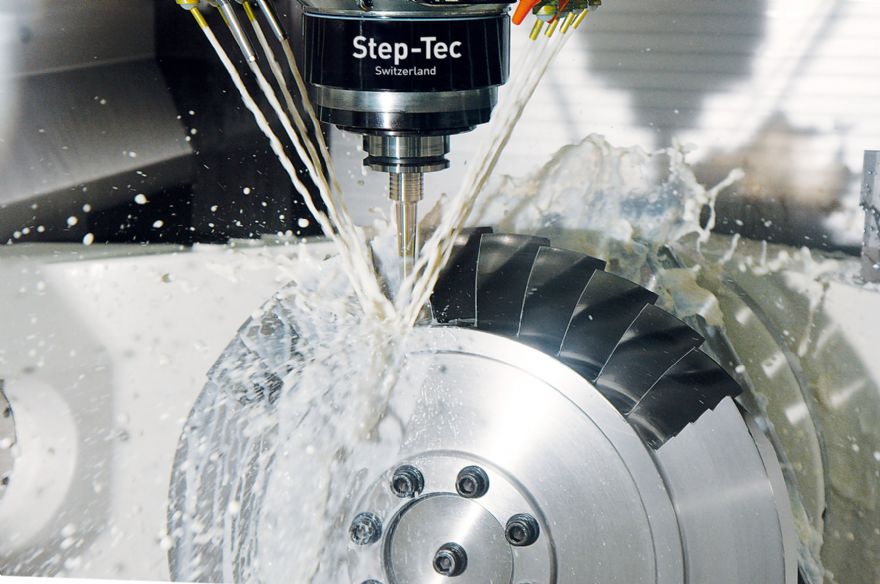
 Pic: Step Tec spindles are part of the integrated package of the Mikron Mill PU Series
The increasing complexity of modern turbo machinery is placing ever greater demands on manufacturers of impellers, where precision, repeatability and efficiency must be achieved in equal measure.
Against this backdrop,
United Machining's Mikron Mill P U series of simultaneous 5-axis machining centres is positioned as a solution tailored to the specific challenges of machining open, semi-open and closed impellers.
Designed with rigidity at their core, the machines combine high torque motors, direct-drive Step Tec, advanced thermal compensation and integrated spindle protection with sophisticated calibration systems. The result, according to the company, is a platform capable of machining intricate impeller geometries more quickly and efficiently, while maintaining the levels of precision required for demanding applications.
Impeller machining itself is recognised as one of the more exacting processes in modern manufacturing. Typically requiring full simultaneous 5-axis capability, it involves the creation of highly complex blade geometries using specialised CAM software and advanced tooling strategies. The process must accommodate a range of operations, from aggressive material removal through to ultra-precise finishing, all while maintaining stability and consistency.
At its core, impeller machining follows a structured, multi-stage workflow. This sequential process, comprising roughing, semi-finishing and finishing, transforms a raw workpiece into a high-precision component capable of performing reliably under extreme operating conditions.
Roughing and High RemovalThe roughing stage focuses on the efficient removal of bulk material and the establishment of the impeller’s primary geometry. This phase is critical from both a productivity and cost perspective, as it accounts for the majority of machining time and material removal. Various strategies can be employed, from Z-level and axial roughing to more advanced 5-axis plunge or adaptive techniques that optimise tool engagement and reduce wear.
In impeller production, cavity roughing and multi-blade strategies are often used to improve efficiency, enabling several blades to be machined in a single operation. Although surface quality is not the primary objective at this stage, careful control of tool orientation remains essential to avoid collisions and ensure consistent performance.
Semi-finishing follows as a crucial intermediate step, refining the geometry established during roughing and preparing the surfaces for final machining. The aim here is to leave a consistent and controlled amount of stock across all surfaces, a prerequisite for achieving optimal finishing results. Toolpaths in this phase closely mirror those used in finishing, albeit with greater allowances and step-over values. This ensures that roughing marks are removed while maintaining sufficient material for stable cutter engagement. In the case of impellers, particularly those with thin and complex blades, tapered ball-nose cutters and end mills are commonly employed due to their enhanced rigidity and reduced susceptibility to deflection and vibration.
Finishing Challenges The finishing stage ultimately determines the component’s dimensional accuracy and surface integrity. It requires precise control over toolpaths, cutting parameters and tool orientation. Strategies such as Z-level finishing are widely used to ensure consistent tool contact and uniform surface quality. However, finishing impeller blades remains particularly challenging due to their geometry. Blades are frequently thin, tapered, twisted and closely spaced, with uneven heights from hub to shroud. To minimise surface defects, it is often recommended that each blade be machined using a single uninterrupted toolpath, maintaining a consistent tool orientation relative to the blade surface. This approach reduces sudden changes in movement and helps deliver a uniform finish.
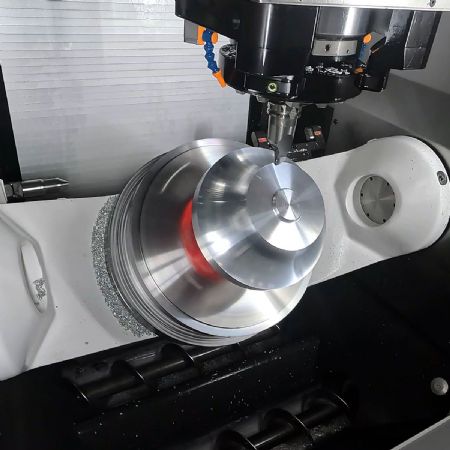
Maximising efficiency across all stages relies heavily on process optimisation, particularly during roughing. Advanced 5-axis strategies, combined with smooth and continuous toolpaths, help maintain consistent material removal and reduce unnecessary machine movements. Effective utilisation of machine kinematics further enhances productivity by minimising the need for repositioning and shortening overall cycle times.
Mikron Mill AdvancesIt is within this demanding environment that the capabilities of the Mikron Mill P U series come to the fore. The machines are designed to address common challenges associated with impeller machining, including difficult-to-machine materials, tool wear and the need for sustained precision. Features such as torque motors and high-performance direct-drive spindles delivering up to 120Nm provide the rigidity and power required for both heavy roughing and delicate finishing operations. The symmetrical machine design contributes to stability and accuracy, helping to ensure consistent results even under high loads.
Automation also plays a key role, particularly in high-mix, low-volume production environments. Integrated solutions allow manufacturers to increase productivity without compromising flexibility, while the option of integrated turning on models such as the Mikron Mill P 800 U enables one-hit machining within a single set-up.
Attention has also been paid to ergonomics and footprint. The machines are designed for ease of access during set-up and maintenance, while their compact layout maximises productivity per square metre of floor space.
Torque motor technology is another defining feature. As a standard specification, these motors enable precise, frictionless motion in simultaneous 5-axis machining. By eliminating mechanical wear and reducing the risk of positioning errors, they contribute to improved accuracy, enhanced vibration damping and extended machine life.
Maintaining precision over time is supported by Automated Machine Calibration (AMC), which simplifies what has traditionally been a complex and operator-dependent task. Through automated cycles and advanced algorithms, the system restores machine accuracy with minimal intervention, reducing the risk of human error and ensuring consistent performance.
Protection of critical components is addressed through the Machine Spindle Protection (MSP) system. In the event of a collision, sensors immediately halt the machining process, preventing damage to the spindle and preserving machine geometry. This not only reduces downtime and repair costs but also allows production to resume quickly following operator intervention.
Completing the package are Step Tec spindles, known for their speed, precision and reliability. Capable of maintaining stability at high rotational speeds, they ensure consistent performance across all stages of machining and across a wide range of materials, from aluminium to titanium.
Taken together, these technologies underline the importance of integrating advanced machine design with optimised machining strategies in impeller manufacturing. The Mikron Mill P U series illustrates how this approach can deliver the stability, accuracy and efficiency required to meet the evolving demands of the sector.