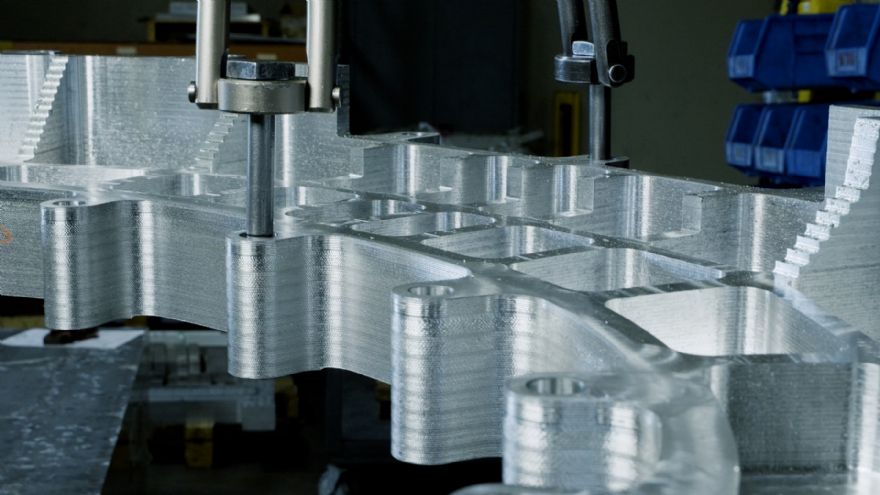
 Pic: Parts being machined on a Starrag Ecospeed F at NotthoffA 12-year relationship between Notthoff Engineering and Starrag is helping the US aerospace subcontractor combine speed, precision and efficiency, driving its ability to deliver complex structural components for the latest defence programmes.
Founded in 1941 as a wartime job shop, Notthoff Engineering has evolved into a highly specialised aerospace subcontractor with a strong focus on high-speed machining of structural components.
Operating from a four-building, 65,000ft² facility in Huntington Beach, California, the company serves major US defence programmes, producing parts for platforms such as the F-35, F-47, F-16 and previously the F-18.
CEO Kelly Kaller describes the company: “Notthoff Engineering is a small, family-owned machine shop that has grown over the years. We produce high-speed, monolithic structural aeroplane parts as well as helicopter components.”
The scale and complexity of its work is striking. Approximately 80% of production is aluminium, with titanium, Inconel and other hard metals making up the rest. Components include ribs, stringers, formers and fuselage sections, often machined from large billets.
COO Arnie Juarez highlights the extent of material removal involved: “To give you an example, we recently had a billet that weighed about 6,800lbs, but when we shipped the part out, it weighed 190lbs. That is 95% material removal, and that is common for us.”
The search for precisionWhen Notthoff began searching for a new horizontal machining centre in the early 2010s, the decision-making process was unusually rigorous. Mr Juarez travelled to Europe to evaluate machines in live production environments, speaking directly to operators and management teams.
One experience proved decisive. “The Starrag sales team invited me to Ireland to see another company where some of their machines were in operation and they all praised Starrag. They were even installing two additional machines.”
By contrast, a visit to a competing manufacturer revealed machines undergoing maintenance and reports of reliability issues.
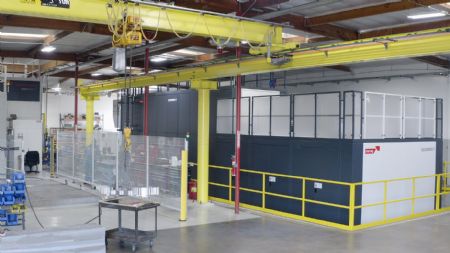 Pic: The Starrag ECOSpeed F at Northoff
However, reliability alone was not enough. What ultimately secured the investment was Starrag’s distinct machine architecture; specifically, the Sprint Z3 parallel-kinematic head, which differs fundamentally from traditional heavy rotating heads.
“Most of the big horizontals from other manufacturers have large, heavy rotating heads, and they’re really slow. With the Z3 Sprint head on the Starrag, it goes from zero to 40 in a split second. The machine just keeps running,” says Mr Juarez.
The Z3 AdvantageAt the heart of the Ecospeed F series is the Z3 Sprint head, designed for high-speed machining of aluminium structures. The system delivers 1G acceleration across five axes, with high jerk values enabling rapid positioning without sacrificing accuracy.
Tim Mooney, Starrag’s national sales manager, is unequivocal in his assessment: “It’s the fastest, most powerful machine out there. 30 to 40% more efficient than every other machine because of the Z3 head.”
Spindle performance is equally critical. The machine operates at 30,000rev/min, with 161 horsepower and a base speed of 13,800rev/min, meaning full power is available at relatively low speeds.
Mr Mooney explains: “Cutting aluminium structures is all about horsepower. If you achieve full horsepower at a lower RPM, you can use a much larger tool and your maximum hourly metal removal rate increases.”
The lightweight nature of the Z3 head (approximately 200kg) compared with several tonnes for traditional designs offers further benefits when machining thin-walled structures. Reduced mass improves control and minimises vibration, allowing aggressive cutting without compromising part integrity.
“With a very light mass to control, thin walls don’t become a problem because we can accelerate through them,” says Mr Mooney.
Two machines, one strategyNotthoff installed its first Ecospeed F 2060 in 2013, bringing large-capacity machining capability with a work envelope of 2m x 6m. More than a decade later, the machine continues to deliver high accuracy and reliability.
“This machine was installed in 2013 and we’re still producing good parts,” says Mr Juarez. “We haven’t had any major overhauls, and it still holds tolerances to within a thousandth of an inch.”
Building on this success, the company recently added a second machine: the more compact Ecospeed F 1540 (1.5m x 4m). Rather than duplicating capability, the two machines complement each other operationally.
“Rather than tie up the big machine with smaller workpieces, it allows us to move that work over to the 1540 and keep them both running,” Mr Juarez explains.
The pairing also allows process optimisation. The larger machine uses minimum-quantity lubrication (MQL), while the newer system runs with flood coolant giving flexibility across different part requirements and materials.
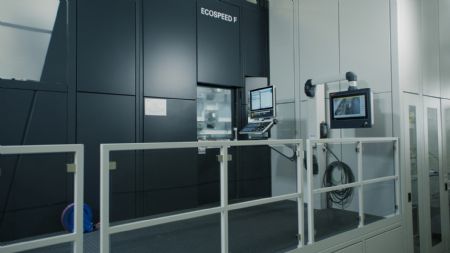 Pic: The viewing area of the Ecospeed F
Both machines feature dual-pallet systems, enabling near-continuous operation. While one pallet is in production, the next job is prepared offline.
“They load the tools, update the programme, and return the machine to cycle immediately,” adds Mr Juarez. Pallet changes take just 120 seconds, supporting 24/7 operation.”
For Notthoff, the investment in Starrag technology is fundamentally about productivity and competitiveness.
“This new machine gives us a nice edge by being very efficient,” says Mr Kaller. “It adds a lot more capability and capacity to our shop.”
Mr Juarez agrees, pointing to faster delivery and better pricing as key outcomes. He says: “The machine allows us to deliver on time with excellent quality, and customers get parts at a really good price because we can machine parts much faster than our competitors.”
Automation features contribute to this advantage. Self-calibration reduces operator dependency, while advanced control systems ensure consistency. All programmes are validated using simulation software before production begins.
The machines also support increasingly stringent OEM requirements, particularly from Boeing. “The new requirements… specify that you have to do everything in the same setup,” explains Juarez. With automatic right-angle heads, the Ecospeed can effectively operate as a 6-axis machine, enabling complex features to be completed in a single operation.
Service and supportWhile performance is critical, Notthoff places equal importance on after-sales support; a factor that strongly influenced its decision to invest again in Starrag.
“There’s nothing worse than buying a machine and finding out afterwards that there’s no service support,” says Mr Juarez. “Starrag has always been really good and they’ve always stood behind their product.”
Remote diagnostics allow engineers to access machines directly, resolving many issues without site visits. When on-site support is needed, response times are typically within 24–48 hours.
This service infrastructure is supported by a significant US presence, including spare parts availability and a network of engineers.
The road aheadWith defence spending rising and demand for advanced aerospace components increasing, Notthoff is well positioned for continued growth. Both Ecospeed machines are fully utilised, and the company is already considering how to expand capacity.
“We like to grow organically,” says Mr Juarez. “We’re kind of out of space and we’ve either got to dispose of some older equipment or invest in another building.”
The partnership with Starrag, now spanning more than 12 years, is likely to remain central to that strategy. As Mr Mooney puts it: “When Starrag sells a machine it’s about building relationships and supporting each other over the years. We’re in it for the long haul.”
A partnership driving precisionNotthoff Engineering’s journey from a modest job shop to a key aerospace supplier underscores the importance of strategic investment in advanced manufacturing technology. By combining high-performance machining platforms with a strong service partnership, the company has built a production model capable of meeting the most demanding requirements of modern defence programmes.
In an industry where precision, speed and reliability are paramount, the long-term collaboration between Notthoff and Starrag demonstrates how the right partnership can deliver sustained competitive advantage and powering both performance and growth well into the future.