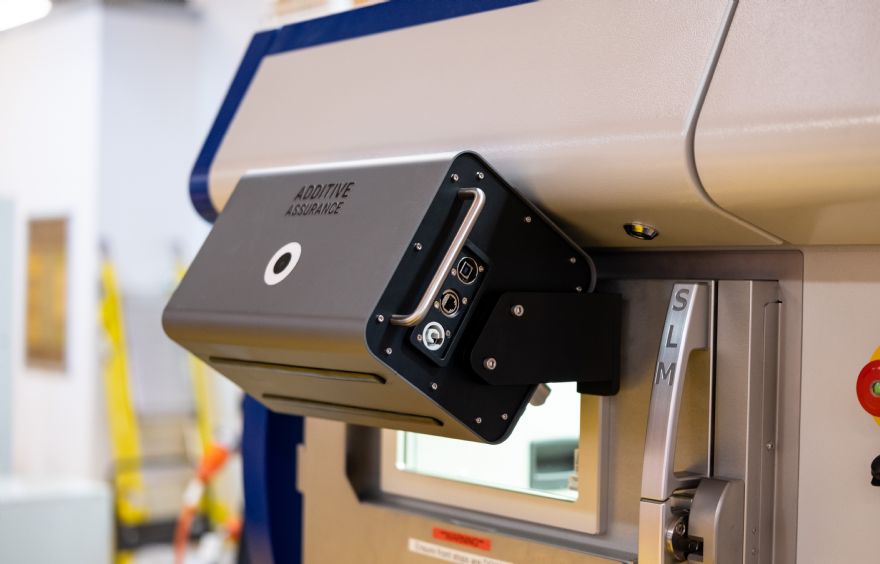
 In this article, Marten Murg, co-founder and CEO of Additive Assurance, who argues that metal additive manufacturing must move beyond blanket inspection towards a risk-based approach that integrates in-situ process data with targeted verification to deliver scalable, economically viable quality.
Metal additive manufacturing does not suffer from a shortage of inspection methods. The real issue is far more fundamental — a lack of credible, scalable inspection strategy. Across the sector, many organisations are still trying to “buy certainty” in the same way they would in traditional manufacturing: inspect more, test more, and document more. In metal AM, that instinct is understandable, but it often works against progress.
When confidence relies on an ever-growing stack of post-build inspection, quality has not been solved. The bottleneck has simply been pushed further downstream and relabelled as governance.
At its core, 100% post-build inspection is not a quality strategy. It is a costly drag on learning and an obstacle to scale. As parts grow larger, denser, more valuable or more time-sensitive, such approaches quickly render metal AM uneconomic.
A more mature alternative is risk-based quality: applying the right evidence at the right moment, at the right cost, to control the risks that matter. This means combining in-situ process data with carefully targeted inspection so that quality becomes an embedded production capability rather than a post-processing ritual.
From detection to decision-makingThe question facing manufacturers is no longer whether defects can be detected. It is whether the evidence available supports confident decision-making.
In regulated sectors such as aerospace, defence, energy and medical, familiar debates persist. In-situ monitoring is often seen as promising but uncertain. Computed tomography (CT) is trusted but slow and expensive. Coupon testing offers some reassurance but fails to represent the actual part. Meanwhile, traceability requirements continue to expand, leaving organisations overwhelmed with data.
These are not purely technical concerns; they are decision challenges. Resolving them does not mean choosing one method over another, but building a structured “evidence ladder” aligned with risk.
Structuring quality evidence around risk
A robust approach to metal AM quality begins with a clear hierarchy of evidence.
First comes design intent and criticality. Manufacturers must understand which failure modes matter and which features are safety-critical, load-bearing or fatigue-sensitive. Without this prioritisation, it is impossible to align inspection effort with risk.
Next is process evidence derived from in-situ monitoring. Capturing what occurs during the build, layer by layer, provides early and comprehensive insight into whether the process remains within defined limits.
This is followed by targeted verification through inspection and testing. Techniques such as CT scanning, coordinate measurement, metallography and mechanical testing should be applied selectively, validating and calibrating process data rather than replacing it entirely.
Finally, governance and traceability ensure that all evidence is structured, accessible and meaningful to quality teams, regulators and customers. Simply accumulating more data does not equate to traceability; what matters is the ability to present coherent proof.
Many organisations still overinvest in inspection because it is familiar, while underutilising in-situ data because it feels less established. Governance considerations are often addressed only when prompted by audits. A risk-based framework addresses this imbalance.
Why in-situ evidence changes the equationPost-build inspection offers a snapshot of the final part. In-situ evidence, by contrast, reveals how the part reached that state. This distinction is critical.
Detecting deviations during production allows corrective action before costly waste accumulates in machine time, material and downstream processes. Continuous monitoring also provides full build coverage, unlike sampling-based inspection regimes that may miss critical defects.
Perhaps most importantly, in-situ data enables traceable root cause analysis. By linking anomalies to specific layers, regions or time points, manufacturers can move from simply identifying problems to understanding their origin.
This does not eliminate the role of inspection, but it allows it to be deployed more intelligently and with greater justification.
Moving beyond the CT versus in-situ debateThe perceived conflict between CT scanning and in-situ monitoring is largely misplaced. The two approaches are not competitors but complements within a calibrated quality system.
CT scanning remains invaluable during early qualification, establishing a baseline against which in-situ signals can be correlated. Once processes stabilise, it can be used periodically to audit performance or investigate anomalies flagged by in-situ data.
This model reflects how mature manufacturing systems operate: establishing correlation, demonstrating detectability and scaling through rational sampling strategies.
Where organisations insist on continuous 100% CT inspection, it often reflects a lack of confidence in process evidence rather than a genuine requirement. Addressing this gap requires elevating in-situ monitoring to the status of formal quality evidence, not treating it as a secondary dashboard.
Defining credible in-situ evidenceFor quality and certification teams, effective in-situ evidence is not defined by volume but by clarity and usability.
It must support decisions directly, enabling clear outcomes such as proceed, hold or investigate without excessive interpretation. It must also be traceable, linking data to part identity, process parameters and acceptance criteria.
Comparability is equally important, allowing manufacturers to benchmark builds against known-good references, detect drift over time and maintain consistency across machines and production sites. In addition, governance requirements must be met, ensuring secure storage, access control and auditability.
Finally, in-situ data must be validated against physical inspection results, ensuring that decisions are grounded in demonstrated correlation rather than assumption. This shift marks the transition from simple monitoring to genuine process assurance.
Building a practical inspection strategyIn practice, risk-based quality strategies tend to evolve in stages.
Early on, the focus lies on establishing correlation between in-situ signals and physical inspection outcomes. This phase relies heavily on CT and other inspection methods to define acceptance thresholds and confidence levels.
As processes stabilise, the strategy shifts towards risk-based auditing. Blanket inspection gives way to targeted checks focused on higher-risk scenarios such as new geometries, machine changes, parameter adjustments or variations in material batches.
At full scale, the emphasis turns to managing drift and change. In-situ data becomes a tool for maintaining consistency, detecting early signs of variation and enabling controlled process adjustments without repeated, large-scale requalification.
This approach does not reduce quality. Instead, it introduces discipline and proportionality into how quality is achieved.
Towards truly industrial AMIf a quality system relies solely on detecting and eliminating defects after production, it reflects a fundamentally fragile process. In such cases, organisations are not scaling additive manufacturing; they are managing uncertainty.
For metal AM to reach true industrial maturity, quality must be treated as a combination of process control and verification, not verification alone. Properly implemented in-situ evidence strengthens existing quality management systems, providing earlier insight, deeper understanding and more defensible outcomes.
For manufacturers facing increasing pressure from cost, lead times and regulatory scrutiny, the path forward begins with a simple question: which decisions need to be made earlier, with greater confidence and at lower overall cost?
Answering that question is the foundation of risk-based quality — and the key to unlocking scalable, industrial metal additive manufacturing.