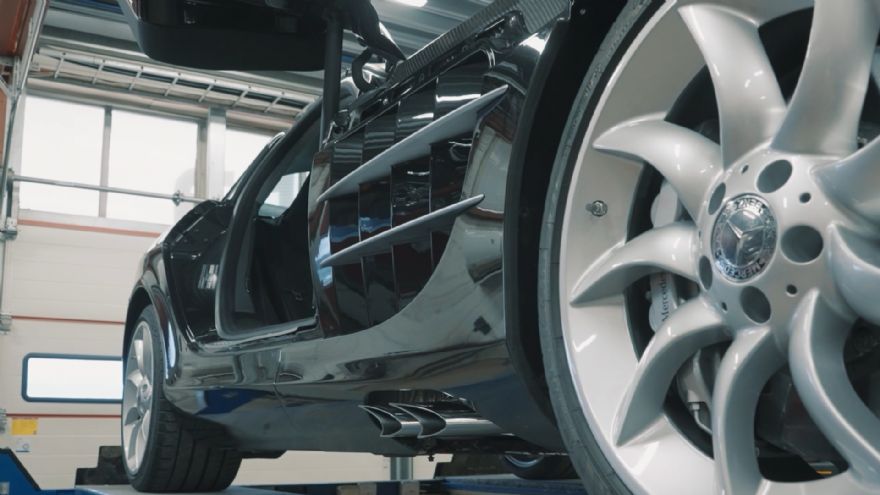
Swedish exhaust systems specialist
Ferrita Sweden AB has demonstrated how wire laser metal deposition (Wire-LMD) technology can dramatically reduce development time and costs while delivering highly customised components for premium automotive projects.
The company recently used the process to create a bespoke exhaust system for a 2003 Mercedes-Benz SLR McLaren, one of the most distinctive supercars of its era. The customer wanted to make the hand-built, supercharged V8 model even more unique, presenting Ferrita with a complex engineering challenge that would have been difficult and costly to achieve using conventional manufacturing methods.
Ferrita, which develops and manufactures solutions for sound attenuation, vibration control, thermal insulation and exhaust gas purification, operates within Sweden's vibrant vehicle customisation sector. This environment encourages the company to push the boundaries of exhaust design and explore new manufacturing technologies.
For the SLR McLaren project, the requirement was to produce four precisely matched tailpipes with a highly specific geometry while maintaining strict deadlines. According to Ferrita, traditional manufacturing techniques would have required dedicated tooling to achieve the required symmetry and repeatability, substantially increasing both costs and lead times.
The timing pressures associated with bespoke vehicle projects added further complexity. Custom fabrication specialists often have a customer's vehicle for only a short period, meaning concept development, design validation and production must all be completed rapidly.
The SLR McLaren's packaging constraints also created significant technical challenges. The original exhaust system was tightly integrated into the vehicle structure, with components packaged within the front fender area. Ferrita's engineers aimed not only to produce a visually striking replacement system but also to reduce weight and improve overall performance.
The company estimated that replacing the original muffler would remove around 20kg from the vehicle while reducing heat build-up and improving exhaust flow characteristics.
Achieving these objectives required more than simply producing a new set of tailpipes. Exhaust system performance depends on the precise control of pipe diameters, internal volumes, flow paths and gas velocities. Manufacturing these complex internal geometries using traditional fabrication methods can be time-consuming and difficult.
As Ferrita technician Viktor explained: "You can't hand-produce a pair of merge pipes with round ends, flow-wise. You can make perfect merge pipes."
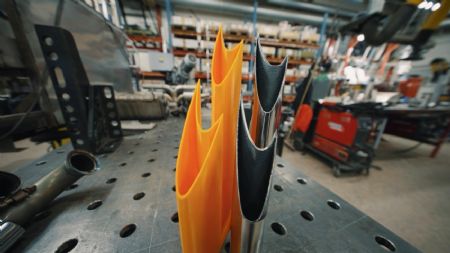 Pic: An additive plastic prototype was manufactured first to test fitment before moving to metal production
To address the challenge, Ferrita adopted a fully digital workflow that combined 3D scanning, CAD modelling, additive manufacturing and rapid prototyping. Engineers first scanned the underside of the vehicle to create an accurate digital representation of the available installation space. This data was then used to develop and test concepts for pipework and valve placement before any physical parts were produced.
A plastic prototype was subsequently manufactured within a few hours, allowing the team to verify fitment and styling before moving to metal production.
The final components were produced using a
Meltio Roboit Cell equipped with an ABB industrial robot and a laser deposition head featuring nine laser beams. The system uses MIG welding wire as feedstock, melting and depositing material layer by layer to create fully functional metal parts.
The tailpipes were manufactured from 316 stainless steel, with the process configured to deliver high levels of dimensional accuracy and surface detail. Printing speeds were set at 10mm/sec, with a gas flow rate of 15 litres/minute and laser power reduced to 1,000W to optimise build quality.
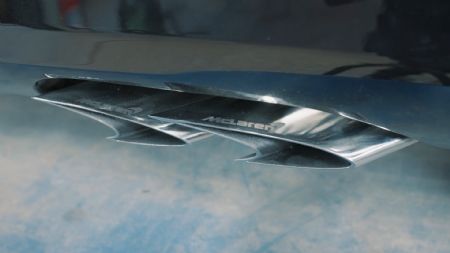 Pic: The completed stainless-steel tailpipes
 According to Ferrita, the use of Wire-LMD technology delivered substantial benefits. By eliminating the need for dedicated tooling, overall project costs were reduced by approximately 50%.
"The time and cost of that for us would probably be close to €4,000, but now, when printing and doing the most to not complicate the part, it probably cost us about half when accounting for all the polishing," a company technician said.
Material efficiency was another advantage. Unlike conventional machining processes that remove material, the Wire-LMD process deposits only the material required.
"And an important part of this is actually that you have no waste. All material is used from the wire," the technician added.
Production speed was equally impressive, with the stainless steel tailpipes completed in around four to five hours. Ferrita noted that the technology also offers flexibility to combine materials within a single build, allowing manufacturers to use heat-resistant alloys such as Inconel in high-temperature areas before transitioning to stainless steel elsewhere.
The company believes additive manufacturing is reshaping the possibilities for low-volume and bespoke automotive production. By combining advanced scanning, digital design and Wire-LMD technology, Ferrita can move from concept to finished component far more quickly than with conventional fabrication methods, while maintaining repeatability and production quality.