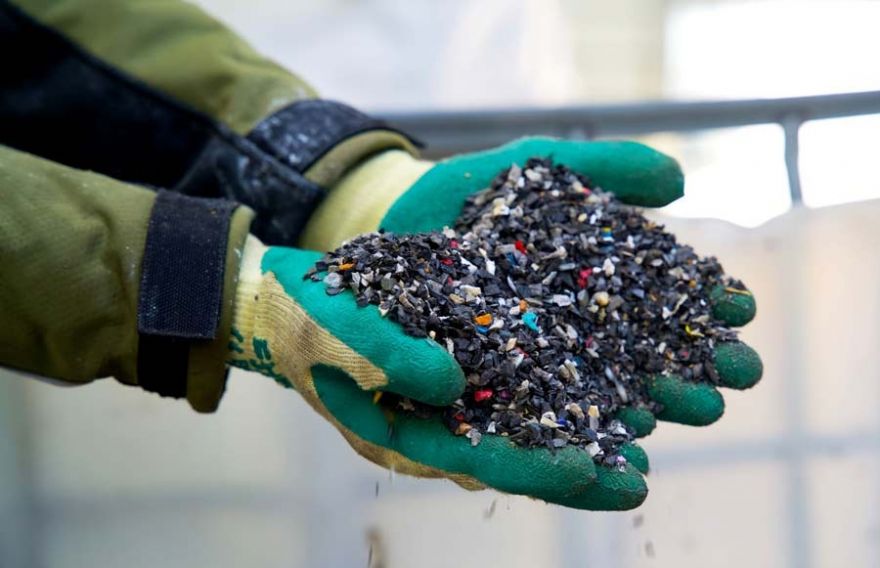
As composite use grows across industries, so too does the challenge of managing materials at end of life. With thermoset composite waste in Europe projected to have reached 924 kilotons, pressure is mounting to improve circularity. Yet sustainability is about more than recycling alone. Here, Kim Sjödahl, senior vice president for technology and sustainability at leading composites manufacturer
Exel Composites, explores how composite sustainability depends not on a perfect, one-size-fits-all recycling solution, but on a multifaceted approach.
Composites are widely used in infrastructure because they’re light, strong for their weight, and resist corrosion. In transport, they help reduce vehicle weight, which improves energy efficiency, while in wind energy they enable longer turbine blades. In these applications, composites already support sustainability by improving performance and lowering energy use during operation.
Yet, the same durability that makes composites appealing can also require more sophisticated end-of-life recycling strategies, especially when hybrid composites are factored into the equation. This reality doesn’t cancel out the benefits, but it does demand a more nuanced approach: one that reduces reliance on finite resources and recognises that circularity begins with design choices, not only end-of-life treatment.
One established industrial recycling pathway for composite waste is its use in cement production, where glass fiber composites are repurposed as a feedstock for cement clinker. The organic resin fraction provides a source of heat energy during processing, reducing reliance on fossil fuels, while the inorganic content displaces virgin raw materials. As a result, cement co-processing has become one of the most commercially viable routes for composite recycling and currently accounts for the largest share of composite waste recovery on an industrial scale.
Alongside these established open-loop routes, a range of emerging technologies is being developed to enable higher-value recovery of composite materials. Processes such as pyrolysis and solvolysis aim to separate fibers from the polymer matrix, enabling recovered materials to be reused in new composite applications through more closed-loop pathways.
Despite these advances, focusing solely on recycling risks overlooks the wider factors that determine the sustainability of composite products. While closed-loop processes are often presented as the ultimate goal for composite circularity, sustainability outcomes are also shaped by decisions made much earlier in a product's lifecycle.
Designing for a long product lifetimeRecycling pathways are only one part of the story. Composites can remain in service for as many as 100 years, making early decisions crucial for maximising sustainability. One of the most effective strategies available to manufacturers is designing composites for a long product lifetime. This means considering material selection closely, including how materials have been sourced as well as how easily they can be identified, separated, and repurposed once their lifetimes are at an end.
This shifts the focus from end-of-life solutions to whole-life design thinking. Rather than treating recycling as a final step, sustainability outcomes are increasingly shaped by how products are designed, specified, and manufactured. In this sense, end-of-life performance is largely predetermined by earlier engineering and material choices.
No single company can achieve circularity alone. Instead, it’s about improving transparency across the value chain, so that material composition, sourcing, and processing information is available to support future traceability. Designing for reuse and recovery may begin with manufacturers, but it is dependent on cooperation between material suppliers, designers, and other industry figures.
Exel Composites’ partnership with
Fairmat, a deep-tech company that recycles aerospace carbon fiber waste, shows how this can work in practice. This scheme uses Fairmat’s robotic cutting technologies to reconstitute carbon fiber components into high-performance “CFRP Chips”. These chips retain much of the original fiber stiffness and strength, allowing production waste to be given a second life as advanced composite building blocks.
Partnerships like this can show how collaboration can help turn circularity from an ambition into tangible circularity routes. Nonetheless, this is also another part in a much larger transition. The composites industry still requires greater transparency about recycling challenges. Being open about the work still required and knowledge yet to be acquired is essential to building credible and collaborative circular sustainability systems.