Manufacturing priorities have shifted. While honing machines were once judged primarily on output, today’s environment is defined by smaller batch sizes, greater product variation and tighter delivery schedules. Success now depends as much on flexibility and fast changeovers as on machining speed.
At AMB 2026, the Nagel Group, comprising
Nagel Technologies,
Kadia,
Gehring Technologies and
FLP Microfinishing, will showcase solutions designed to meet these changing demands. Spanning flexible honing, high-productivity series production, deep-hole machining and AI-assisted surface finishing, the technologies share a common objective: combining precision, adaptability and productivity.
For high-mix, low-volume manufacturers, Nagel Technologies has developed the EasyHone VRX flexible honing centre. Designed for SMEs and subcontractors, the modular platform can be expanded as requirements grow, offering a scalable route into honing technology.
Its flexible architecture includes up to 1,200mm of X-axis travel, a large T-slot table and adaptable fixturing, allowing a wide range of components to be machined with minimal retooling. Multiple fixtures can be prepared offline, helping reduce downtime and improve utilisation.
Digital tools enhance that flexibility. The HonAssistant software supports programme creation and process control, while an optional pneumatic air-gauging system measures bore diameters during machining, eliminating manual checks and improving process reliability. By embedding specialist knowledge within the system, the machine also helps address growing skills shortages. Suitable for applications ranging from bushings and compressor parts to cylinder blocks, the EasyHone VRX combines repeatable accuracy, short setup times and user-friendly operation in a cost-effective package.
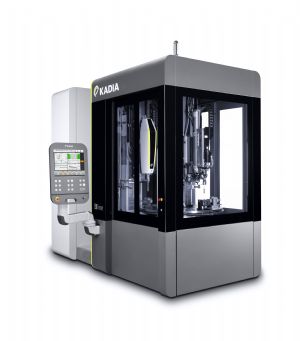
Achieving flexibility is only valuable if quality is delivered immediately after a product change. Kadia’s third-generation U line has been developed to ensure production reaches specification from the first component.
Targeting sectors including hydraulics, aerospace, defence, medical technology and pharmaceuticals, the machine features a rotary table enlarged by 30%, 60% more working space and improved accessibility, reducing changeover times and supporting flexible automation. Options range from small-batch handling systems to fully unmanned production cells.
At its core is the HMC100 control, which continuously monitors machining and combines multiple honing strategies within a single cycle. Together with the LH2x honing spindle and its three direct drives, the system delivers higher dynamics, increased material-removal rates and greater process flexibility. Integrated form honing ensures repeatable bore geometries, while intelligent controls reduce dependence on operator experience.
In one automated production cell, different precision components are manufactured with cycle times below 10 seconds. Setup times have been cut by around 20%, while machine availability, process capability and overall equipment effectiveness have improved. The result is lower unit costs, reduced scrap and quality from the first component.
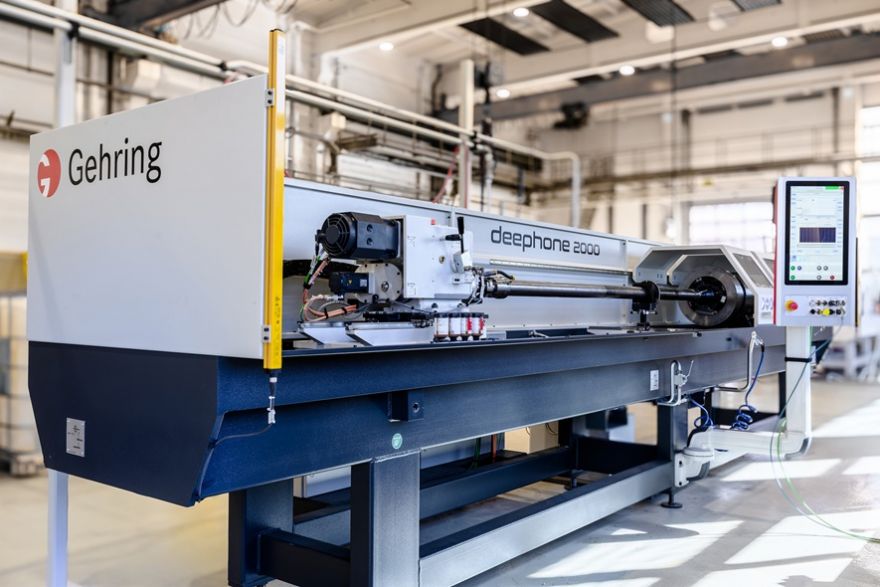
Where component lengths extend into metres rather than millimetres, maintaining accuracy presents a different challenge. Gehring Technologies has responded with a modular deep-hole honing platform for long hydraulic cylinders, shafts and tubular components.
Instead of relying on bespoke machine designs, the platform uses standardised modules to configure systems for component lengths from two to ten metres. This approach reduces engineering effort and shortens quotation and delivery times while retaining the flexibility needed for customer-specific applications.
Combined with gearbox options, the latest GCU 3.x control system and integrated tooling and abrasive technology, the platform is designed to deliver precision and process reliability over the full length of the component. Applications include industrial, energy and plant-engineering sectors where customised solutions and short lead times are increasingly critical.
At the opposite end of the precision spectrum, FLP Microfinishing is focused on ultra-precision surface finishing, where tolerances are measured in nanometres rather than microns.
Its modular HE series supports double-sided fine grinding, lapping and polishing for applications including semiconductors, optics and medical technology. The HE 540, developed for thin-walled and geometrically demanding components, can process glass wafers, sapphire, carbide and ceramic materials with high levels of stability and repeatability.
A key differentiator is the integration of mechanics, software and control technology. FLP’s proprietary plane-surface machining system achieves flatness and parallelism values down to 0.01 micrometres. AI-enabled functions monitor machining performance, recommend process improvements and support process optimisation, helping manufacturers maintain consistency while reducing reliance on specialist expertise.
The benefits of intelligent process control are already evident within the Nagel Group, where an Industry 4.0 production cell has exceeded its original performance targets by more than 50%. For manufacturers, that translates into higher productivity, improved process stability and greater cost-efficiency.
The Nagel Group will exhibit at AMB 2026 (15-19 September) in Stuttgart, Hall 5, Stand 5C30.