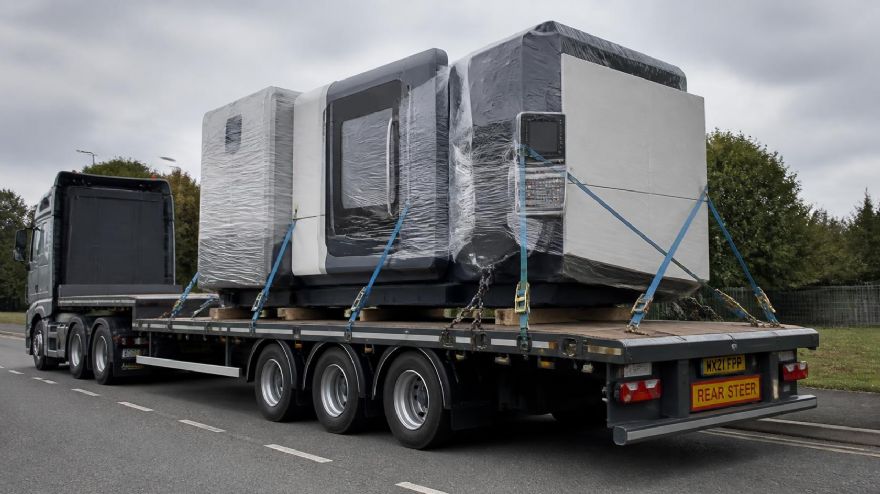
Getting a heavy machine ready for transport is not the same thing as putting ordinary goods on a pallet.
By the time a lorry reaches the loading bay, most of the work that determines whether the collection goes smoothly should already have happened. The machine needs a suitable base, the weight has to be understood, anything loose must be dealt with and the dimensions supplied to the carrier need to describe the finished shipment, not the machine as it stood on the factory floor.
That sounds straightforward. In practice, it is where plenty of industrial movements begin to go wrong.
Building from the bottom upThe first question is whether the base is actually suitable for the machine being shipped.
Weight alone does not tell the whole story. A 700kg machine with a broad, even footprint behaves very differently from one carrying much of its weight through two narrow mounting points. Motors, gearboxes and side-mounted equipment can also move the centre of gravity well away from the middle of the machine.
A standard pallet may be perfectly adequate in some cases. In others, the sensible answer is a heavy-duty skid, stillage, cradle or crate designed around the equipment itself.
The centre of gravity should be understood before the machine is secured. The aim is not necessarily to make it geometrically central, which may be impossible, but to create a stable load with the weight properly supported and controlled during lifting and transport.
Secure solutions to suit the machineShrink wrap can protect surfaces and keep covers in place. However, it should not be mistaken for load restraint. Heavy machinery may need a combination of bolting, blocking, bracing and rated restraints. Depending on the load, those restraints might include chains, webbing, banding or another engineered method.
Steel banding has a place, particularly on some rigid or crated loads, but it is not automatically the right solution simply because the freight is heavy.
The securing arrangement should work with the machine’s proper structural or mounting points. Control panels, guards, pipes and cabling should not end up carrying forces they were never designed to take.
Where straps or banding pass over an edge, suitable protection can reduce cutting and abrasion. Anti-slip material can also be useful beneath some loads, but it is an aid to a proper restraint system rather than a replacement for one.
The basic test is simple: the machine should be stable on its transport base before anyone starts thinking about how that base will be secured to the vehicle.
When to measureOne of the easiest errors to make is measuring too early. A manufacturer’s dimensions may describe the machine accurately but say nothing about the skid, crate, protective frame or components that remain attached for transport. The carrier needs the size of the freight that will actually be collected. That means measuring the complete length, width and height after preparation is finished, including anything that overhangs the main body.
The same principle applies to weight. The figure supplied should be the best available transport weight for the complete consignment, not simply a catalogue figure for the bare machine.
“A machine can be measured perfectly and the booking can still be wrong,” says George Wicks-Farr, head of operations at
Pallet2Ship. “We see it when the skid or protective frame gets added afterwards, or a control box sticks out beyond the original footprint. The vehicle has been planned around one set of dimensions, and a different load is waiting at collection.”
An
oversized pallet guide can help teams establish a consistent way of measuring irregular freight before requesting transport.
Lifting the loadThe collection site also needs to be able to handle what has been booked. If the machine needs a forklift, crane or specialist lifting equipment, that should be established before the vehicle is dispatched. Fork access, lifting points and any restrictions around the loading area all matter.
The delivery end deserves the same attention. Equipment loaded under an overhead crane at a manufacturing plant may be arriving at a smaller site where only a forklift is available. A transport plan that works at one end of the journey does not automatically work at the other.
Check what’s insideLoose tools, detachable guards and moving components should be secured or removed as appropriate. Doors, covers and panels should not be able to swing open during handling.
Liquids and batteries need checking rather than assumptions. Fuel, oil, coolant, refrigerants and batteries can affect carrier acceptance or dangerous-goods requirements depending on what the machine contains, how much remains, the route and the mode of transport. It is therefore better to confirm the position with the carrier than to apply a blanket rule that every machine must be completely drained.
The same applies to unusual lifting characteristics. If the centre of gravity is not obvious, or the machine has designated lifting points, that information should travel with the load.
Preparing heavy machinery properly is ultimately about removing surprises. The right base, the right measurements, suitable restraint and clear handling information make the transport job easier for everyone who touches it afterwards.