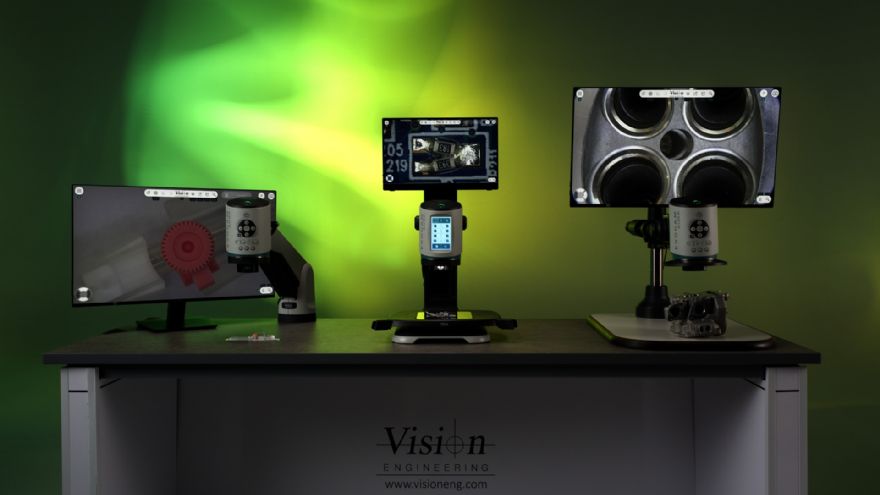
 Vision Engineering has expanded its EVO Cam digital microscope range with the launch of EVO Cam Aura, a new inspection system designed to deliver higher image quality, greater functionality, enhanced connectivity and improved inspection consistency. In this Q&A Machinery Market's Online Editor Ed Hill spoke to Stephen Sanderson, Group Product Manager at the company, to find out more.Q) Vision Engineering has recently introduced the EVO Cam Aura. Can you tell us what it is and how it builds on the success of the Evo CAM II?
EVO Cam Aura is the latest addition to our EVO Cam range of digital inspection systems. EVO Cam II has been a very successful product for us over the last few years, and Aura builds on that foundation. We've taken the principle of a high-specification digital inspection camera and significantly enhanced it in a number of areas, adding both new capabilities and improved performance.
Q) Are you seeing increasing demand for digital inspection systems in manufacturing?Yes, definitely. The market for digital inspection cameras continues to grow. More manufacturers are moving towards digital inspection solutions because they want greater functionality, better image quality and improved efficiency. Users today expect more from their inspection systems, and our aim with EVO Cam Aura was to deliver exactly that.
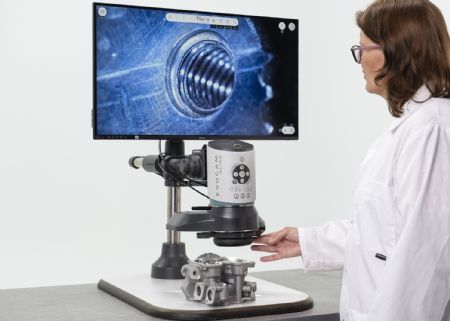
Q) One of the headline developments is the move to 4K resolution. What are the benefits of this?The development of EVO Cam Aura was based around four key pillars, the first being image quality. Moving from Full HD to 4K gives users significantly higher resolution and makes it much easier to see fine details.
That means being able to identify smaller defects more clearly, which is critical in many inspection applications. We've also found that 4K sensors offer improved dynamic range, helping users inspect difficult or reflective surfaces where lighting and reflections can sometimes obscure detail.
To complement this, we offer a range of eight objective lenses, allowing users to adjust the overall magnification of the system to suit different applications.
 Q) Software development appears to be another important area. What improvements have been made?
Hardware and software need to work together. We manufacture our own optics and combine those with the 4K imaging capability, but we have also developed the software to help users optimise images for different inspection tasks.
Users can adjust contrast, colour and other image settings to get the best possible view of the component they are inspecting. Beyond image enhancement, we've added a broad range of tools including annotation, measurement and comparison functions.
The objective is to allow users to perform more tasks within a single system. Rather than moving images to a separate PC for analysis, many operations can now be completed directly on the camera. That reduces workflow steps, improves efficiency and lowers dependence on operator skill levels.
Q) So users can effectively work from a single inspection station rather than moving data between different systems?Exactly. The less time users spend transferring images and switching between systems, the more productive they can be.
 Q) Connectivity also seems to have been a major development, why is that?
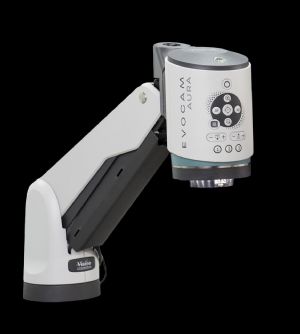
A) We wanted EVO Cam Aura to integrate seamlessly into customers' existing working environments. We offer a wide range of lenses, stands and lighting options so the system can be configured for different applications. At the same time, Aura can connect via Wi-Fi, Bluetooth or LAN, allowing captured images to be saved directly to network locations without requiring an intermediary PC.
Importantly, the system is designed to comply with the Cyber Resilience Act (CRA), providing the security protections required when equipment is connected to a network.
Q) Is that because Cybersecurity is becoming increasingly important for manufacturers?Yes. Manufacturers need confidence that their data and intellectual property are protected. For customers with particularly stringent security requirements, we can also provide variants with connectivity removed entirely, allowing the system to operate in highly secure environments.
Q) Which industries and applications do you see EVO Cam Aura being used in?One of the advantages of digital inspection systems is their flexibility. Anyone manufacturing products will require inspection at some stage, and EVO Cam Aura can support a wide variety of tasks.
It can be used for incoming goods inspection, assembly operations, process monitoring, final quality checks and specialist applications such as tool wear assessment or surface-finish inspection.
A smaller company may use one system for a wide range of jobs, while larger manufacturers may deploy multiple systems performing dedicated inspection tasks. Aura is designed to accommodate both approaches.
Q) Consistency is a key challenge in inspection. How does EVO Cam Aura address this?Consistency was one of our core development priorities. We wanted to give users confidence that inspections are carried out correctly every time.
Aura allows settings to be copied between systems, ensuring multiple workstations operate with identical configurations. Whether inspections are carried out by different operators, at different locations or on different shifts, results remain consistent.
We've also introduced automatic lens detection and screen detection. When automatic settings are enabled, the system configures itself accordingly, reducing the possibility of operator error.
 Q) So, in effect you're engineering out some of the variability that naturally comes with human operators.
Exactly. There will always be some variation, but if we can eliminate simple mistakes and automate routine adjustments, we can help users achieve more reliable and repeatable inspection results.
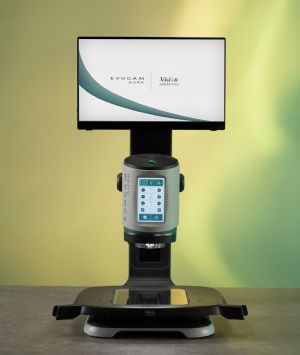
Q) There are three models in the EvoCam Aura range. What are the differences?Our flagship model features a touchscreen interface. Most people are now very comfortable using touchscreen technology, and it provides an intuitive user experience alongside 4K imaging, interchangeable optics and flexible lighting options.
We also offer a button-controlled version. Some users work in environments where gloves are worn, and many simply prefer physical controls. This version provides the same 4K imaging performance and functionality but replaces the touchscreen interface with buttons.
The third model offers Full HD resolution rather than 4K while retaining many of the same software capabilities and hardware options, providing a lower-cost entry point into the range.
Q) When will EvoCam Aura be officially launched?The official launch will take place on 14 September to coincide with the IMTS in Chicago and AMB show in Stuttgart. That's when we'll formally unveil the product globally.
The systems are manufactured here in the UK and will be available worldwide following the launch. Demonstration units are already with our teams and partners around the world, so customers can arrange demonstrations through their local Vision Engineering representative.
Q) Finally, what would you say to current EVO Cam II users considering an upgrade?EvoCam II remains an excellent product, but EVO Cam Aura builds on everything it does. Users gain higher image quality, more functionality and significantly improved efficiency.
Features such as built-in measurement, annotation tools, additional comparison modes, expanded overlay capabilities and internal memory all help streamline inspection tasks. Many functions that previously required a PC can now be carried out directly within the system.
Ultimately, EvoCam Aura allows users to do more, achieve better inspection results and work more efficiently, all within a familiar and compact platform.
You can see the full interview with Stephen Sanderson from Vision Engineering here: