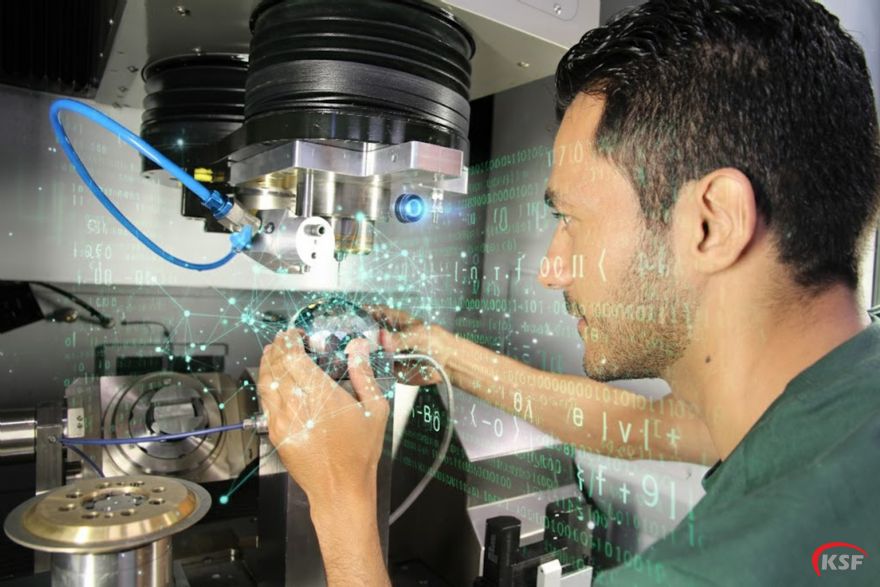
Fully automated, data‑driven production technologies are rapidly transforming grinding machines into intelligent manufacturing partners, as artificial intelligence, sensor systems and advanced process control deliver increasingly productive, flexible and self‑optimising operations. These developments will be on full display at
GrindingHub 2026 in Stuttgart from 5-8 May, where the sector’s leading manufacturers will meet to present a wide range of new high‑tech solutions.
From unmanned closed‑loop production and stream finishing to automated compensation, sensor packages and AI‑driven precision processes — including grinding applications for humanoid robot components — the exhibition is set to highlight significant steps forward in grinding technology.
Marie‑Sophie Maier, managing director of
Adelbert Haas GmbH in Trossingen, said: “With intelligent automation 4.0, we have long since heralded the change — intelligent, fully automated complete manufacturing has overtaken traditional complete machining. Today, extremely high productivity and flexibility are essential, as is zero compromise on precision. Turnkey grinding?
That is no longer enough. We are in demand as a partner who has mastered end‑to‑end digitalisation and automation and is putting this into practice!” At Adelbert Haas, fully automated closed‑loop manufacturing — grinding, measuring and re‑grinding to final perfection — now runs for 21 shifts each week without manual intervention.
Ms Maier notes that service is also undergoing fundamental change. She said: “Service is not a reaction, but prevention. Our Customer Care Centre solves problems before they arise. AI agents analyse machine data in real time, detect anomalies, and initiate measures before a shutdown threatens — automatic ticket creation, prioritisation of critical alarms, log files at the touch of a button.
Rule‑based programming is a thing of the past. Today, we learn from data and act proactively.” She believes
GrindingHub 2026 offers the ideal setting to demonstrate how automation and AI are reshaping grinding, and how Haas’s solutions will contribute to the future of manufacturing.
Automation and production controlAutomation and digital control will also take centre stage for
Anca Europe GmbH. Managing director Martin Winterstein said: “At
GrindingHub, in addition to presenting new products for stream finishing and the manufacture of indexable inserts and micro-tools, we will be focusing on automation and production control. The goal is to help users manufacture competitively under their given conditions through high quality, low manufacturing costs, and creative solutions.”
Anca will showcase a server‑based digital production control system featuring app‑guided worker instructions and automated measurement and compensation. Operating like a traffic controller for tool production, it directs pallets and machines through each stage of an order while giving operators clear, step‑by‑step guidance. The system integrates seamlessly with existing Anca and
Zoller machinery, digitalising workflows and ensuring full traceability.
For operators, digital work instructions replace manual file handling, automatically preparing programs, indicating measurement points and guiding responses to results. A closed measurement loop with automatic compensation ensures batches remain within tolerance without requiring operators to calculate offsets. All data is stored centrally, allowing skilled staff to manage more machines, reducing waste and easing training for new employees.
Grinding technologies are also playing a central role in the fast‑growing field of humanoid robotics. Transmission components, responsible for transferring force and movement between joints and actuators, demand high accuracy, low noise and exceptional surface quality.
Jan Schmid, head of engineering and project planning at
Erwin Junker Maschinenfabrik GmbH in Nordrach, explained: “Our grinding machines guarantee high dimensional and geometrical accuracy, process reliability, and flexibility with high output. Thanks to our many years of experience in thread grinding, we are able to offer customised grinding solutions for all types of threads. Our expertise guarantees maximum precision and quality – even for complex requirements.”
For components such as robot joints and drives, the company supplies specialised solutions using ceramic and electroplated CBN wheels and grinding pins. Internal thread grinding allows threads to be produced directly from solid material, including cone and ball threads and specialised profiles, even with internal diameters below 10 mm. Nuts with challenging diameter‑to‑length ratios can also be machined reliably.
Mr Schmid explained: “When grinding threaded spindles, even threads with high pitch angles can be produced thanks to the flexible machine concept. In addition to cone and ball threads, we manufacture custom profiles that are precisely tailored to customer requirements. For maximum flexibility, we offer solutions for single‑tooth machining and multi‑tooth machining for particularly high output. Come and see our grinding solutions for yourself at GrindingHub in Stuttgart.”
Reshaping precision grindingAdvances in sensor technology and AI are also reshaping precision grinding. Professor Bahman Azarhoushang, head of the KSF Institute at
www.hs-furtwangen.de/en Furtwangen University, said: “Current developments in precision grinding show a clear trend toward integrated, closed control loops at machine and process level.” He noted that modern machine tools now combine conventional path control with real‑time sensor monitoring, in‑situ measurement systems and, increasingly, adjacent measuring cells such as coordinate measuring machines, all aimed at increasing process efficiency and productivity without sacrificing accuracy or surface finish.
Sensors mounted throughout the machine generate continuous data streams — from force and vibration monitoring to spindle current and voltage readings — which AI models use to predict grinding wheel wear, detect anomalies or forecast component quality. This enables automatic optimisation of parameters such as feed rate, cutting speed or in-feed. The resulting process database builds long‑term expertise independent of individual operator experience.
Professor Azarhoushang said: “Modern intelligent grinding machines integrate particularly dynamic drives, high‑resolution measuring chains, and adaptive control algorithms that continuously analyse and autonomously optimise the grinding process.”
He views intelligent grinding technologies as a decisive step toward robust, self‑optimising manufacturing systems. Integration with existing production environments remains a key challenge, both technically and organisationally. He continued: “Looking at
GrindingHub, it becomes clear: The future competitiveness of industrial manufacturing locations depends largely on how consistently grinding processes are digitalised, automated, and operated in closed control loops. Intelligent machine tools and AI will play a key role in this.”
Grinding technology is undergoing a period of profound change as suppliers and users alike face increasing demands. Automation, digitalisation and AI‑supported control systems are transforming traditional processes into high‑performance, self‑optimising manufacturing environments. Fully automated closed‑loop systems are already helping manufacturers achieve greater quality, flexibility and cost‑effectiveness, even under demanding conditions.
With advanced sensors, intelligent production control and predictive service, the industry is rapidly shifting from reactive to preventive operation.
GrindingHub 2026 will offer a comprehensive view of how these technologies are reshaping competitiveness across the manufacturing spectrum.