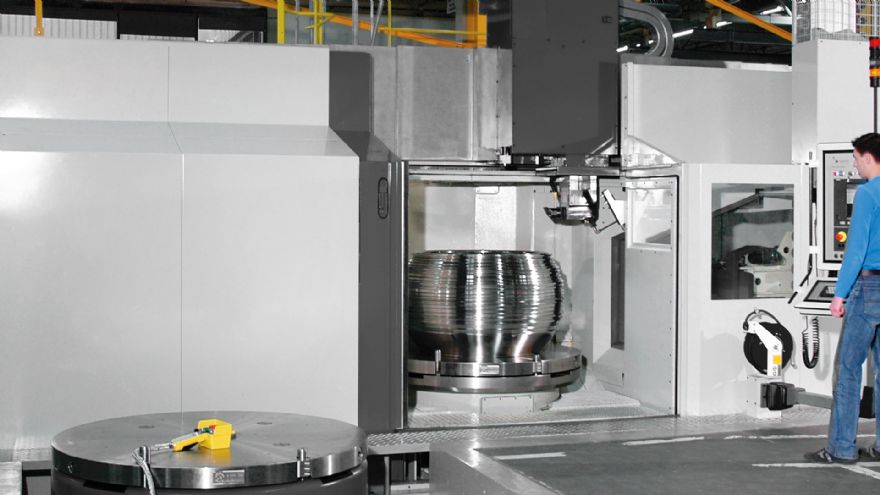
In both the aviation and energy sectors, turbine manufacturers continue to rely on
Starrag machines for the production of engine blades, blisks and, increasingly, complex turbine housings. The company’s portfolio draws on decades of development work and offers solutions for every stage of casing manufacture, from small precision components to some of the largest housings used in power generation.
Engine, steam and gas turbine casings vary significantly in scale and are becoming more intricate, particularly as manufacturers turn to materials such as titanium, Inconel and advanced high‑alloy steels. These factors often require multiple machining technologies to be brought together, ideally within a single system or a flexible manufacturing environment. Starrag’s broad machine range enables it to cover the full scope of these demands.
The STC series represents the company’s core solution for large turbine casings, providing five‑axis heavy‑duty machining for diameters up to 3.3m. Designed for efficiency when working with demanding materials, these machines offer high rigidity and precision across roughing and finishing operations. For smaller casings, Starrag offers the Heckert X series in MT design, which combines turning and milling capability on one machine. The five‑axis variants extend this further, with a rotary swivelling table that is particularly useful for producing angled holes frequently required in casing manufacture.
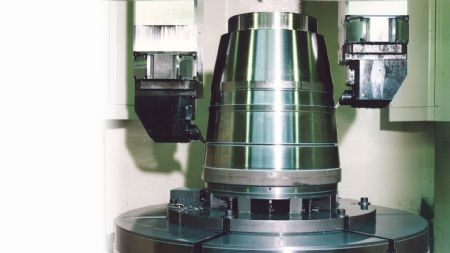
For very large steam and gas turbine housings — up to 12m in diameter — Starrag turns to Droop+Rein portal machining centres produced in Bielefeld, alongside large vertical Dörries lathes used for similar applications.
The Berthiez vertical turning and grinding machines, produced in St Etienne, add further capability and are widely used in aircraft construction where combined turning and grinding is essential. Ultra‑precision operations such as fine boring, milling and jig grinding are supported by Starrag’s SIP machines, built in Vuadens, Switzerland. The same facility produces Bumotec turn‑mill centres for small, highly accurate components such as injection nozzles used within the wider casing assembly.
Starrag’s UK subsidiary TTL plays a significant role in the maintenance, repair and overhaul of turbine housings. With its specialism in Siemens NX CAM and expertise in adaptive milling processes, TTL provides MRO support that enables worn or damaged housings to be restored following build‑up welding and precision machining. The company says the housings can be returned to an almost‑new condition.
Core competenciesAlexander Fitz, sales director for aerospace and turbine at Starrag AG, emphasised the breadth of the company’s capability: “Machine tools are one of our core competencies, which no other company in the world can offer in terms of their technological breadth and varying sizes. We also have an in-depth technical understanding of the entire process chain required to manufacture ready-to-install turbine housings.”
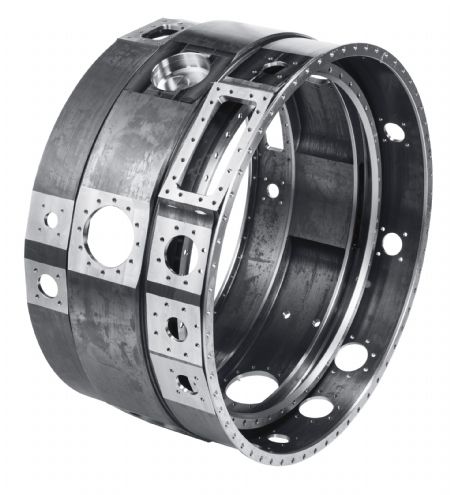
This comprehensive approach extends to the integration of multiple operations. Klaus Struebel, segment sales manager aerospace & turbines at Starrag, noted that combining milling, turning and grinding — supported by Starrag’s own angle heads and specialised attachments — reduces clamping positions and improves productivity.
He said: “If one machine is not sufficient for machining, we can combine our different product ranges in flexible manufacturing systems, for example a Starrag STC with a Berthiez vertical turning/grinding centre. Standardised interfaces and pallets allow us to speed up the process and increase accuracy. If required, we integrate additional washing, drying, and measuring processes.”
Starrag’s tooling expertise contributes further to process capability. For many years, the company has developed and manufactured carbide milling cutters specifically tailored to the needs of machining titanium, Inconel and other difficult materials. These tools are typically customised for the component, machine, and cutting conditions, offering faster machining and longer tool life than standard solutions.
Interchangeable angle headsMr Struebel highlighted one example — the internal bores in casings. He explained: “Especially the internal ones, these are a major challenge in housing machining. We develop special interchangeable angle heads for this purpose, and these also have to be able to cope with the limited space available.” He notes that similar expertise applies to deep‑hole drilling in small diameters, where tight tolerances are essential.”
The company’s gear spindle, manufactured in Rorschacherberg, remains one of its key assets. Designed for thermal and mechanical stability during long machining cycles — often up to 80hr — it is used in both STC machining centres and Droop+Rein gantry machines. A range of special heads is also available for these machines, offering different lengths, torque ratings and spindle speeds.
Mr Struebel concluded: “We provide our customers with higher productivity by looking at the entire process. We don’t just sell a product, we make sure that the machine fits the machining application in terms of size, technology, axis configuration and kinematics, and then optimise the process with the appropriate peripherals.”
Much of this work is carried out at the Aerospace Turbine Competence Center (ATCC) in Rorschacherberg. Covering approximately 2,000m
2, the facility houses the latest four‑ and five‑axis Starrag machining centres and is staffed by developers and application specialists. The ATCC also supports customers with test machining and small batch production, enabling processes to be developed and proven before they are transferred to full‑scale manufacturing.