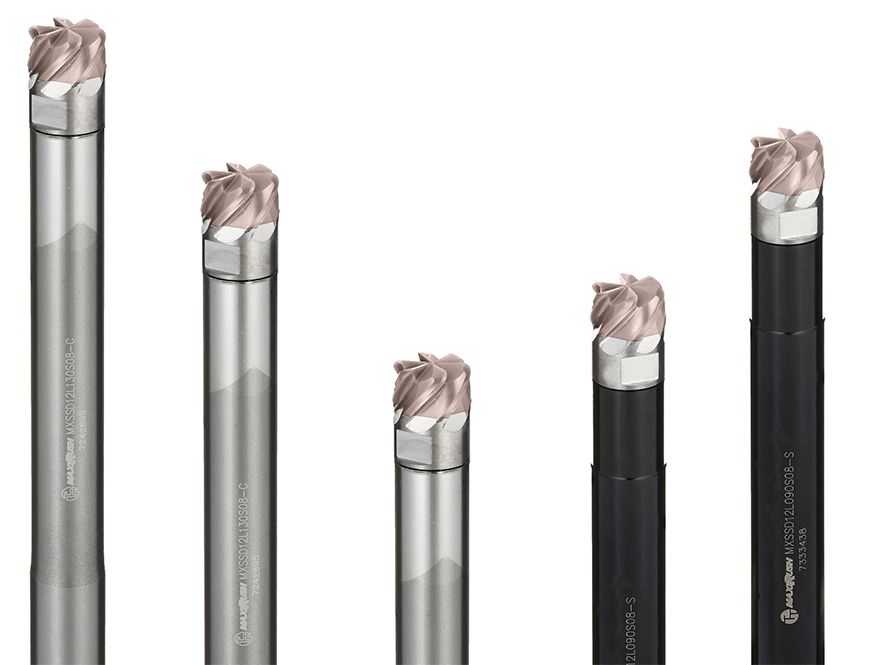
 The CERAMICSFEED line from TaeguTec
The industry-leading CERAMIC-SFEED milling line from
TaeguTec has now been significantly expanded with the introduction of ceramic brazed end mills and MAXI-RUSH heads. This expansion delivers a comprehensive high-speed milling solution for heat-resistant superalloys in the aerospace, offshore and power generation sectors.
The enhanced range addresses the demanding requirements of nickel and cobalt-based alloy machining, where conventional solid carbide tooling witnesses rapid performance deterioration. It is here that the new CERAMIC-SFEED system excels. It exploits the fundamental thermal properties of ceramic cutting materials to achieve dramatic productivity improvements in heat-resistant alloy applications.
Whereas carbide tools experience rapid wear at elevated temperatures and require conservative cutting speeds around 50m/min, TaeguTec's TC3030 SiAlON ceramic grade maintains exceptional hardness at temperatures exceeding 1,000°C. This thermal stability enables cutting speeds beyond 700m/min, dramatically improving productivity and reducing cycle times. The impressive CERAMIC-SFEED generates sufficient heat to soften the workpiece material, and this subsequently facilitates aggressive material removal with extended tool life.
The newly introduced ceramic brazed configuration addresses a critical limitation of monolithic ceramic tooling. By brazing ceramic cutting heads to carbide shanks, TaeguTec has substantially reduced the brittleness inherent in all-ceramic designs while maintaining thermal performance characteristics. The hybrid construction delivers superior vibration damping during operation.
It enables more secure tool holding, factors that prove essential when operating at the elevated spindle speeds required for optimal ceramic tool performance. Stability of ceramic tooling has long been a concern for manufacturers; TaeguTec dispels this concern with its hybrid solution.
Specific machining requirementsThe expanded product portfolio comprises five distinct configurations addressing specific machining requirements. The CRFB 6 is a six-flute ceramic brazed end mill presented in diameters from 6 to 16mm with corner radii of 0.5-2mm that has been optimised for shouldering, facing and ramping operations.
The MXCRF ceramic brazed MAXI-RUSH heads provide identical cutting geometries with the added versatility of interchangeable head systems that are compatible with multiple holder configurations. Standard ceramic end mill variants include both four-flute CRF 4 design for slotting applications and the six-flute CRF 6 for high metal removal operations, while the CRH 4 series delivers specialised geometry for high-feed facing operations at shallow axial depths.
Recent comparative trials demonstrate the technology’s substantial performance advantages in production environments. Shouldering operations in nickel alloys using a 16mm dia MXCRF tool achieved productivity improvements of 1,580% compared to conventional carbide end mills. Tool life simultaneously increased 400% from single-part capability to five components per cutting edge.
The machining methodology requires specific operational protocols to maximise ceramic tool performance. Down milling remains essential to prevent rapid cutting edge deterioration, while maintaining cutting speeds above 700m/min ensures sufficient heat generation to soften workpiece material. Coolant application should be avoided to prevent thermal shock and edge cracking. However, an air blast may be employed where swarf evacuation proves problematic.
The complete CERAMIC-SFEED expansion is available now in TaeguTec’s TC3030 grade, which is suitable for nickel alloy applications with impressive performance characteristics in cobalt alloys. The technology specifically targets roughing operations in turbine components, combustor housings and other critical aerospace and power generation applications.