The Franco-German software developer
CoreTechnologie has presented the latest version of its solution for simplifying complex CAD data. The latest version 4.9 of 3D_Evolution Simplifier makes greater use of information in 3-D models, such as Product Manufacturing Information (PMI), attributes and design features, for targeted simplification. This enables the fully automated creation of light and precise digital twin models, designed for high performance deployment across all 3-D systems.
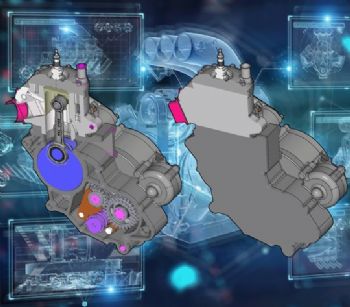
The 3D_Evolution Simplifier is used to remove the model’s internal geometry. Highly complex assemblies are converted into significantly reduced envelope geometry models in a matter of seconds. The individual models remain high-quality, closed CAD solid models, while bodies that are not visible from the outside are removed.
At the same time, filter mechanisms utilise information like attributes and CAD metadata to automate the data simplification process. This results in lightweight, IP-protected models that are ideally suited for simulation, virtual factory planning and other 3-D data-driven applications in the context of Industry 4.0.
The simplified envelope models accurately represent the visible shape of a product or system, whilst internal details are specifically removed. The result is particularly lean data models that ensure high performance in visualisation, simulation and VR applications, while at the same time significantly improving the clarity of complex structures.
Fine balanceIn the context of digital twins, reduced-envelope geometry models play a central role. Digital twins require a balance between geometric accuracy and efficient data processing to avoid performance issues and facilitate integration into simulation and analysis environments. Targeted simplification results in high-performance models without unnecessary geometric complexity. This enables the rapid processing of large assemblies and supports the scalability of digital twin applications, for example in factory planning or in digital mock-up applications for vehicles, as well as in the aerospace sector.
Another key advantage of envelope geometry lies in the protection of intellectual property. By removing the design elements and the entire internal geometry, sensitive design details are completely erased and cannot be reconstructed. This enables companies to securely share 3-D data with partners, customers and value chain networks without revealing their know-how. At the same time, the external structures relevant for collaboration and simulation are retained.
The integration of simplified models into existing processes is supported by interfaces to common CAD formats such as Catia V6 and V6, NX, Creo, SolidWorks, as well as JT and STEP. The intelligent combination of automatic geometry simplification, data conversion and data correction makes 3D_Evolution Simplifier 4.9 a key component of modern PLM processes and lays the foundation for the efficient, rapid and scalable creation of digital twin models.