With version 2026 of hyperMILL,
Open Mind Technologies is increasing both the speed at which NC programs can be created and process reliability. For the first time, the software and its NC code-based simulation in hyperMILL Virtual Machining will support additional tool types and angle heads.
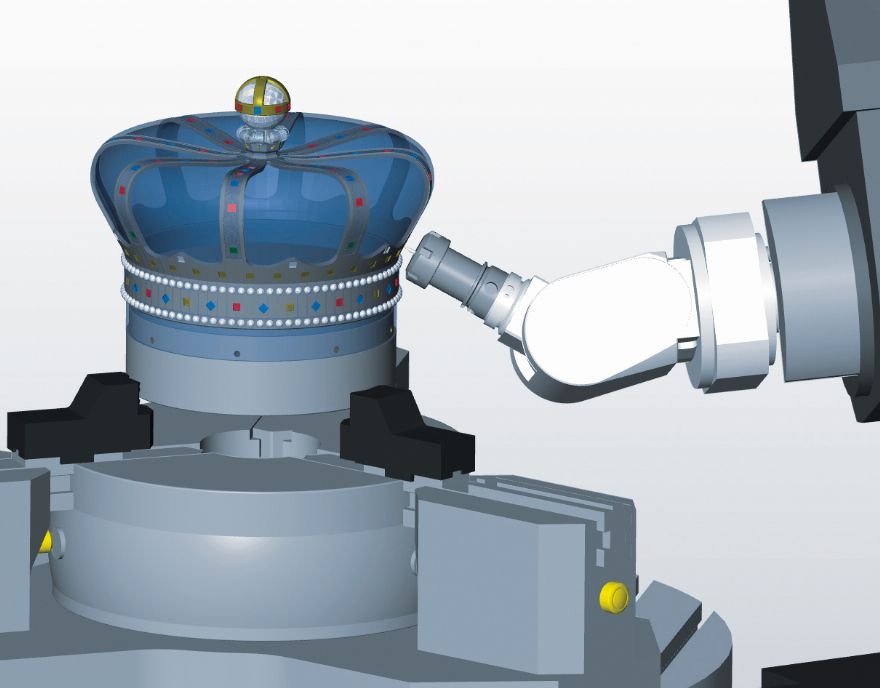
Version 2026, makes it possible to seamlessly integrate angle heads into hyperMILL CAM programming. The angle head is defined as part of the NC tool and configured via the hyperMILL Tool Builder. The virtual machine consistently accounts for angle heads during NC code generation, toolpath optimisation, simulation, and collision checking.
Even critical phases such as the angle head approach and retraction are completely and reliably simulated. The hyperMILL Virtual Machining Optimizer automatically optimises toolpaths for angle head machining. Approaching via a curve also enables safe access to hard-to-reach areas of the component. The function is initially available for Siemens (SINUMERIK 840D) and Heidenhain controls.
2D Hale machining2D Hale machining, also known as contour planning, is another tooling option supported by both machining strategies and in the simulation. This enables impeccable, scratch-free surface finishes, as required for sealing surfaces in battery manufacturing, the semiconductor industry and the mould and die industry. As a trailing axis, the spindle axis ensures that the tool is continuously guided perpendicular to the contour.
Rest material machiningRest material machining has been further automated in version 2026 of hyperMILL. The calculation algorithms for the ‘Z-level,’ ‘Parallel,’ and ‘Normal’ machining strategies have been redesigned to make processing of rest material areas more reliable and efficient. As a result, rest material areas are detected more precisely and machined more reliably. Feed specifications are reliably considered, resulting in more uniform toolpaths.
Additionally, the system automatically integrates a smooth overlap in steep, flat and transitional areas during entry and exit movements. This automation applies to both 3D and five-axis machining. In the latter case, users can use the new ‘Minimum Clearance Angle’ option to specify a minimum distance between the tool shank and the part, ensuring that machining is performed with a defined clearance angle.
Turning and mill-turnWith ‘CAM Plan Turning,’ hyperMILL offers end-to-end programming support for turned and mill-turned parts. Often, turning programming only includes geometries without tolerances, fits, or manufacturing information. Until now, this data had to be added manually, a time-consuming and error-prone process. ‘CAM Plan Turning’ enables turning contours to be quickly and consistently enriched with all relevant manufacturing information. This significantly reduces programming time and provides greater process reliability for turned and mill-turned parts. The hyperMILL Turning Solutions have also been expanded to include new complex turret-type machine configurations for improved collision checking.
Optimised controlLastly, in the hyperMILL Electrode module, the control of eroding paths has been improved, for more flexible use of feed and rapid movements that optimise eroding paths and shorten machining times.