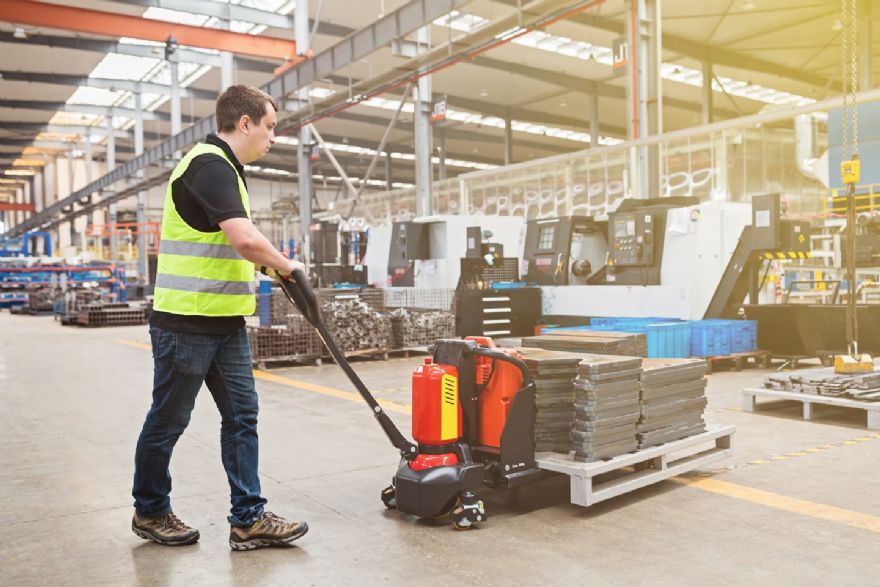
For most mid-sized UK manufacturers, Lean thinking has long been applied to the production line itself — cycle times, changeover durations, defect rates. Yet a significant share of operational waste sits not in the machines, but in the space between them. Internal logistics — the movement of materials, components, and finished goods across the warehouse floor — is where Lean principles are still underutilised, and where the financial losses are quietly stacking up.
The good news: addressing intralogistics waste does not require a six-figure investment. It requires a structured approach, the right framework, and a willingness to challenge habits that have been in place for years.
The 7 Wastes Don’t Stop at the Production LineTaiichi Ohno’s original Muda framework, developed as part of the Toyota Production System (TPS), identified seven types of waste — transportation, inventory, motion, waiting, overproduction, over-processing, and defects. All seven appear on the warehouse floor, often in forms that go unnoticed precisely because they are so routine. Research published in the proceedings of the 2026 Conference on Production Systems and Logistics (CPSL) confirms that lean principles applied to intralogistics must address the full value stream — not just production — to deliver measurable performance gains.
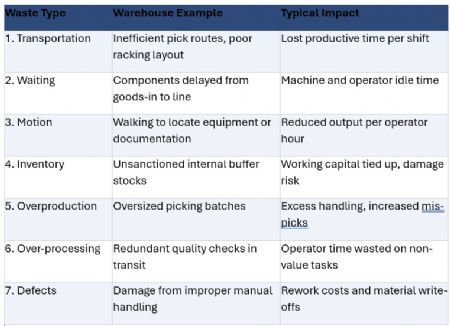
Each of these waste categories has a cost that is already being absorbed by the business — whether or not it appears on a management report. The first step in any lean intralogistics programme is making that cost visible.
Standardising Your Handling Equipment: The Quickest Lean Win AvailableOne of the most overlooked contributors to intralogistics waste is a mixed fleet of handling equipment. Many UK manufacturing sites operate a collection of pallet trucks and powered vehicles acquired over years — different brands, different load capacities, different maintenance schedules. The result is unpredictable availability, inconsistent operator training requirements, and a maintenance burden that grows with every additional model variant.
Standardising on a reliable range of pallet trucks — rather than operating a mixed fleet of ageing equipment — is one of the quickest wins available to lean teams working within tight capex constraints. When every operator works with the same equipment, the benefits compound quickly:
• Training time drops across the entire warehouse team
• Maintenance becomes predictable, with a simplified spare parts inventory
• Visual management systems — colour-coded zones, designated parking positions, capacity markings — function more effectively with a uniform fleet
• ROI can often be recovered within 12 to 24 months through reduced downtime and lower maintenance spend (timelines vary by fleet size and utilisation rate)
For facilities running lean intralogistics programmes,
pallet trucks from a quality assured range provide the operational reliability that ad hoc procurement rarely delivers. Beyond pallet trucks, standardisation logic applies equally to racking configurations, labelling systems, and pick-path layouts. Each element of the warehouse floor that operates to a defined standard reduces the cognitive load on operators and the variability that lean programmes are designed to eliminate.
Kaizen Workshops on the Warehouse Floor: What UK Manufacturers Are DoingKaizen — the principle of continuous, incremental improvement — is well established in UK production environments. Toyota’s UK manufacturing operations at Burnaston, Derbyshire, have long demonstrated how structured problem-solving at the team level drives measurable gains without large capital expenditure. The same methodology translates directly to internal logistics, though it requires a deliberate focus on the warehouse as a value stream in its own right, not merely a support function.
A typical intralogistics Kaizen event runs over three to five days. The team — usually a mix of warehouse operatives, a production supervisor, and a lean facilitator — maps the current material flow, identifies the highest-impact waste categories, and implements changes before the event closes. The emphasis is on solutions that can be enacted immediately: repositioning a racking bay, redesigning a pick route, or establishing a standard location for frequently used equipment. Where budgets allow, some sites extend these gains further with collaborative robots for palletising, order picking and
intralogistics material handling — though the core Kaizen wins remain resolutely low-cost.
UK manufacturers who have applied this model to their warehouse operations report measurable reductions in internal transport distances — in some documented cases exceeding 25–30%, according to published lean logistics case studies — alongside improvements in on-time delivery of components to the line. The investment is primarily time, not capital.
The key to a successful warehouse Kaizen is scoping. Events that try to address the entire logistics operation in one pass tend to produce surface-level changes. Focusing on a single material flow — from goods-in to a specific production cell, for example — produces deeper, more durable results.
ROI Without the Spreadsheet Paralysis: When Better Equipment Pays for ItselfThe reluctance to invest in handling equipment often comes down to an inability to quantify the return. Without a clear ROI framework, capex requests for pallet trucks or racking upgrades struggle to compete with production-focused investments that come with cleaner numbers.
A practical starting point is to measure the cost of the current situation rather than the benefit of the proposed one. Calculate the fully loaded cost of equipment downtime — maintenance callouts, lost operator hours, and production stoppages caused by unavailable handling equipment. Add the cost of operator injuries attributable to poor ergonomics:
HSE guidance on manual handling makes clear that employers must avoid, assess and reduce the risk of injury from hazardous manual handling — and the associated costs extend well beyond sick pay.
Against these figures, the cost of a standardised, well-maintained fleet of pallet trucks becomes straightforward to justify. Facilities that have made this shift report not only reduced downtime but measurable improvements in operator confidence and throughput consistency — outcomes that feed directly into on-time delivery performance and customer satisfaction metrics.
The lean principle here is simple: waste has a cost, and that cost is already being paid. The question is not whether to invest, but whether to keep paying for inefficiency or redirect that spend into a one-time improvement.