The global semiconductor industry relies on highly specialised process equipment, and for
M-O-T Mikro und Oberflächentechnik GmbH, producing that equipment increasingly means bringing key manufacturing processes in-house.
The Saarbrücken-based company has significantly expanded its plastics machining capabilities in recent years, supported by the introduction of the
Mapal NeoMill-Diamond-FlyCutter, a tool originally developed for machining aluminium.
Established in 2001 and part of the
Woll Group since 2011, M-O-T designs and manufactures wet chemical process systems used in microsystem technology and semiconductor production. Employing around 30 people, the company operates from a dedicated area within one of Woll’s manufacturing facilities, producing highly specialised equipment that supports wafer processing during chip manufacture.
Despite being located within a broader engineering environment, M-O-T's production area operates under strict cleanliness standards. Outdoor footwear is prohibited and the workspace is maintained at a slight positive pressure to minimise contamination. Although not a cleanroom, the controlled environment is essential for manufacturing equipment destined for cleanroom operation at customer sites.
With the exception of electronic components, M-O-T’s systems are almost entirely constructed from plastics. Designed on a modular basis, the equipment incorporates individual process stages that can be combined to suit specific semiconductor manufacturing requirements. Process cells handle wafer treatment operations, while integrated storage tanks contain the acids, solvents and other chemicals used during production. Depending on customer requirements, systems can also incorporate electroplating and photolithography processes.
In-house productionThe company manufactures chemical storage and process tanks from thermally welded plastic sheet, selecting materials according to application requirements. Polypropylene (PP) and PVC are commonly used, while higher-performance materials such as PEEK, PVDF and PTFE are employed where greater chemical resistance or temperature stability is required.
Demand for M-O-T's systems has risen sharply. Whereas the company was producing only five or six systems annually in 2021, output has increased to between 20 and 30 systems a year. Growth in semiconductor investment has played a role, but so too has the increasing complexity of the equipment.
The decision to expand in-house manufacturing capability was influenced not only by growth but also by quality concerns with outsourced components. Repeated leakage issues arising from externally supplied parts convinced the company that greater production control was required.
As a result, M-O-T began investing in its own machining capabilities from 2022 onwards. The solution eventually arrived through a combination that might seem unconventional: a modelmaking-style CNC machine, a cutter originally developed for aluminium machining, and a disinfectant-grade liquid used as coolant.
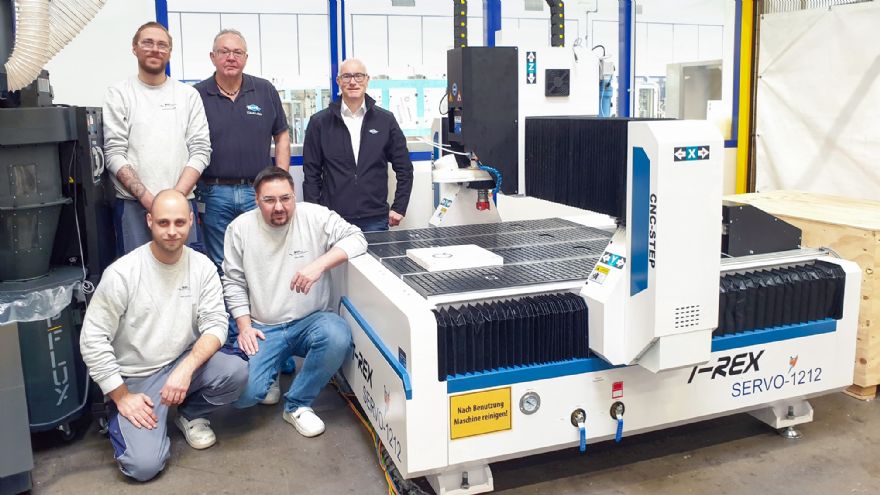
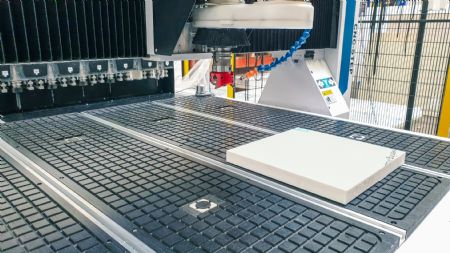
Tool searchThe chosen machine was a CNC-Step T-Rex open-frame milling machine equipped with an SK30 spindle interface and a vacuum table capable of handling workpieces up to 1,000 x 1,000mm. Finding a suitable cutting tool, however, proved far more challenging.
Surface quality was critical to the application, and production manager Mike Jakob spent almost a year evaluating alternatives.
“We weren’t happy with the quality we were getting at the start,” he said. “I spent a year looking for a suitable cutter head, but nobody was able to offer us a product that was completely suitable for the surface finish. It was while attending AMB 2024 in Stuttgart that I found what I was looking for with Mapal, who had a milling cutter for our connection.”
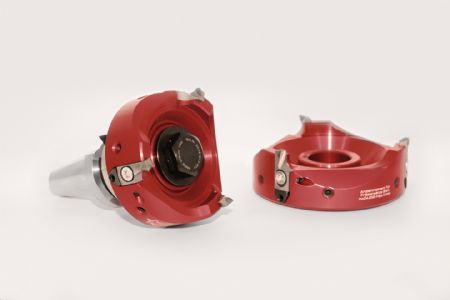
Working alongside Mapal application engineer Klaus-Dieter Leick, M-O-T selected a 63mm diameter NeoMill-Diamond-FlyCutter for the application.
Leander Bolz, from Mapal’s Component Management team, explained: “We originally developed this tool for machining aluminium components in the electronics industry, where our aim was to produce a surface during face machining that was as close to perfection as possible.”
Mapal believed the tool's characteristics made it equally well suited to plastics machining, particularly because it had been developed for lightweight machine concepts featuring small spindles and vacuum clamping systems.
The triple-edged cutter incorporates a specialised geometry designed to reduce cutting forces and evacuate chips efficiently from the cutting zone. While these features were originally intended to improve aluminium machining performance, they also proved highly beneficial when processing plastic materials.
Expanding capabilityAccording to M-O-T, the introduction of the NeoMill-Diamond-FlyCutter has transformed its machining operation.
When the CNC machine was first purchased, the original intention was simply to produce enclosure doors. As confidence and capability grew, the company steadily expanded its in-house production activities.
Today, M-O-T manufactures all of its chemical storage tanks internally and is preparing to bring process cell production in-house as well. Only highly specialised components, including certain PTFE tanks, continue to be sourced externally.
The NeoMill-Diamond-FlyCutter is used primarily for face milling plastic sheet, while contouring and side machining operations are carried out using a Mapal PCD end mill.
Further optimisationDespite the success achieved so far, M-O-T continues to refine the process. One challenge is tooling wear when machining PVDF, a material that is both rigid and brittle. Cooling options are limited because any contamination introduced during manufacture could compromise the chemical purity requirements of the final equipment. Oil-based coolants are therefore unsuitable.
The company initially selected isopropanol as a coolant because it evaporates rapidly and leaves little residue. However, its strong odour limits practical use within the workshop environment.
According to Robin Kollmann, responsible for milling operations at M-O-T, plastics create additional thermal management challenges compared with metals.
“Plastics absorb less heat than aluminium,” he explained. “This means that the heat cannot be dissipated from the component rapidly enough. As a result, chips may fuse or clump together, which builds up more pressure and might potentially damage the cutting edge. The quality of the surface finish is also not as good as we would like it to be.”
Current machining parameters include a spindle speed of 6,000rev/min and a feed rate of 1,200mm/min, significantly lower than the values originally proposed for the application. Material removal during face milling is typically 0.3mm per pass, with stock allowances reaching up to 1mm depending on material grade and sheet quality.
Alongside ongoing isopropanol trials, M-O-T has begun evaluating a new water-based coolant and is also testing increased cutting speeds to improve productivity without compromising tool life or surface finish.
The next stage of development is already under way. Following successful trials, the company has ordered a larger 100mm diameter version of the NeoMill-Diamond-FlyCutter. Thanks to Mapal’s modular tooling system, changing cutter diameters is straightforward, with milling heads from 63mm to 160mm using the same arbor interface.
For M-O-T, the project demonstrates how the right tooling solution can unlock new manufacturing possibilities. What began as an effort to improve surface quality has evolved into a broader strategy of increasing self-sufficiency, improving quality control and expanding production capacity to support growing demand from the semiconductor sector.